Ted Schekirke Grower Interview
Mar. 2nd 2026
DATE OF INTERVIEW:
INTERVIEW ID:
PV-NE-GROW-03
YEARS EXPERIENCE:
17
STATE:
Nebraska
ROLE:
Grower
CULTIVARS:
Frontenac, Brianna, Chambourcin
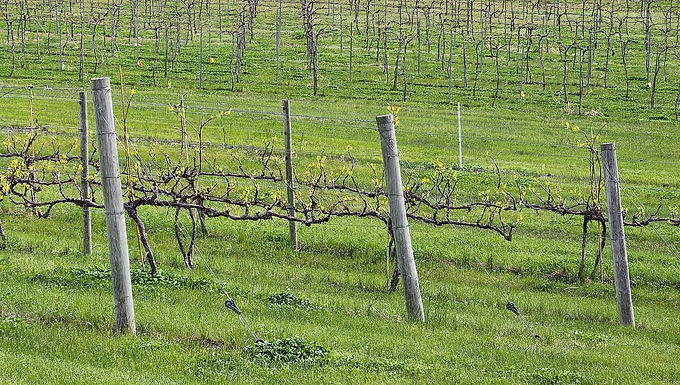
Ted Schekirke’s entry into viticulture began as a "big hobby" helping out his brother-in-law, but it quickly evolved into a three-acre test of endurance against the Nebraska elements. Over nearly two decades near Union, Ted has traded the "prevailing wisdom" of vertical shoot positioning for the practical efficiency of high-wire systems, learning firsthand that the prairie requires constant adaptation. His vineyard is a map of hard-won lessons, from battling 90-mile-an-hour straight-line winds that flattened his Frontenac rows to outsmarting a dozen raccoons sliding under his electric fence.
For Ted, the vineyard is less about the bottom line and more about the discipline of the work. Whether he’s troubleshooting the decline of his aging Brianna vines or nursing a difficult block of Chambourcin through a brutal winter, he remains one of the few original growers from his era still in the field. It’s a labor-intensive retirement plan that keeps him out of the house and deep in the dirt, proving that staying in business in Nebraska viticulture is a badge of honor all its own.
Tyler Bertsch: Hey Ted, how did you first get into growing grapes?
Ted Schekirke: I started by helping out my brother-in-law.
Tyler Bertsch: Did he have acres of grapes, or did he own the land before you, or how did that happen?
Ted Schekirke: Yeah, he had some land east of Union. We just decided to plant a few acres of grapes, and I went out and helped him plant and do some of the maintenance and pruning.
Tyler Bertsch: What was the first year you guys planted grapes?
Ted Schekirke: That I did or he did?
Tyler Bertsch: When did you first plant grapes?
Ted Schekirke: Our first planting was in 2009. We planted Chambourcin.
Tyler Bertsch: And then what did you plant after that?
Ted Schekirke: In 2009 we planted Chambourcin. In 2010 we planted Brianna. And then in 2018 we planted Frontenac.
Tyler Bertsch: How did you learn? Did you figure it out yourself, or did your brother teach you, or did you guys go to any events? How did you guys learn?
Ted Schekirke: A combination of things. Going to the conferences and workshops, and online, books, periodicals, and picking people's brains. I relied on Paul Reed and Steve Gamet quite a bit.
Tyler Bertsch: Was there any mistakes you made early on that you wish you would have done different?
Ted Schekirke: Oh, yeah.
Tyler Bertsch: Let me hear them.
Ted Schekirke: When I first started, it was more of a big hobby type thing. I really planted some vines in the backyard to see how they would work, and decided I'd like to go larger scale, so that's when I found some property to plant the grapes. There was a lot of trial and error. I think knowing what I know now with the Chambourcin, it would have been better if I'd put in irrigation. I didn't know that. The prevailing thought at that time was it was silty clay loam soil and would hold moisture, so it really didn't need it. I think with the Chambourcin, it would have benefited if I'd had irrigation. The Brianna seemed to handle the dryness much better. When I put that on VSP (Vertical Shoot Positioning), it probably would have done better on the high wire. I eventually converted it to high wire, but it would have been better if I had started out that way.
Tyler Bertsch: What about your Brianna and Frontenac? Were they all on high wire to start?
Ted Schekirke: The Brianna was on VSP because that was the prevailing thought at the time: put everything on VSP. It looks nice, but it's higher maintenance.
Tyler Bertsch: Did you get more grapes? Do you think you harvested more or less?
Ted Schekirke: It's too early to tell because I converted the Chambourcin over. Chambourcin is a bigger deal because I started on VSP and it did well up until about years seven or eight, and then it went into steep decline. There was a lot of grapevine trunk disease. So that's when I cut that down to the ground and started training it all back to high wire. It's been really slow to get going again, and I don't think it's really recovered from that grapevine trunk disease. I think it would have been better off if I just ripped it all out and started with something else, but lesson learned.
Brianna is vigorous. It's done well on VSP, but it's on the decline now too. I am in the process of training that up to the high wire and then seeing if we can get the production back up again. The problem with Brianna is it's in decline. Cordon arms on the ends or the spur points are starting to die back and just not getting enough strong shoots.
Tyler Bertsch: When did you notice the decline? How many years ago did you start to notice it?
Ted Schekirke: Probably about a couple of years ago. I used to get close to about eight thousand pounds, about four tons off of it. But it's dropped about a ton now over the last couple of years.
Tyler Bertsch: Interesting. Is it just lots of blank spots of the spurs?
Ted Schekirke: Yeah.
Tyler Bertsch: Gotcha.
Ted Schekirke: And that's the other thing too. When I planted the Chambourcin and the Brianna, the thought was then that if you get a long enough shoot, go with it. But I've since learned that you're better off just bringing that shoot up. That first cordon arm should be about fifteen to eighteen inches, and cut it off at that point, and then grow another fifteen to eighteen inches. So you don't have apical dominance in the middle. I had a lot of that with the Brianna, and I think that's been part of the problem. It probably would have been more productive if it wasn't for that.
Tyler Bertsch: Did you notice any trunk disease on Brianna?
Ted Schekirke: No, not really. But there might have been a few vines here and there that died off in the last couple of years, but I never sent them anywhere to get examined. Overall, as far as the Brianna, I've only lost a couple of vines since I planted them in 2010.
Tyler Bertsch: Out of how many acres?
Ted Schekirke: It's about three-quarters of an acre. I don't even have a full acre of Brianna. It was producing pretty well for what I had.
Tyler Bertsch: Yeah, that's incredible. So your whole vineyard is about—did you say two or three acres? I can't remember if you mentioned that or not.
Ted Schekirke: In grape acres, it's about three. I've got 1,700 vines overall.
Tyler Bertsch: Gotcha. Was there any other—go ahead, sorry.
Ted Schekirke: I was just going to say, if I'd been younger and had more time, I probably would've looked for a better site. I just ended up getting what I could get. So I'm dealing with it. It's not an ideal site, but I'm just making it work.
Tyler Bertsch: Was there any other things you would do different if you started over again?
Ted Schekirke: Yeah, I probably would've had a better site. But even with this site, I think I would've gone through and had the whole site ripped because it was a corn and bean field, and I think the compaction's been an issue, especially with the Chambourcin. I just needed to get that hardpan ripped up, and I didn't do that. I think I was just too much in a hurry, and I should have taken my time and done that right. I think that would've made a big difference. Rip the soil, do better site preparation. As I said, I would've planted everything on top wire to start with, not VSP; it would've been a lot less maintenance. And then the end posts, I would've done those differently too.
Tyler Bertsch: Did you have trouble with the wind in VSP real bad?
Ted Schekirke: Not in the VSP with the Brianna or the Chambourcin. Now, the Frontenac was planted farther down the hill, closer to the creek on our site, and that was planted on top wire to begin with. I have had issues with the wind on the Frontenac. One year it knocked down part of one row, and then year before last, it knocked down five complete rows.
Tyler Bertsch: What kind of posts? Do you use wood or metal?
Ted Schekirke: I use metal. I want to make it easier for machine harvesting. End posts are wood, but the interior posts are metal. They weren't strong enough. So what I did when they got knocked down two years ago is, on the outside rows, I went in and put some wood posts in there to give it some more strength.
Tyler Bertsch: How deep did you put those metal posts or the wood posts?
Ted Schekirke: They're all eight feet, so they're two feet down.
Tyler Bertsch: Two feet? Got you. Do you know what wind speed knocked it down?
Ted Schekirke: Best we could figure is about ninety-mile-an-hour straight-line winds.
Tyler Bertsch: Oh, man. Yeah, that'll do it.
Ted Schekirke: Funny thing is, I had a woodshed sitting down there that was empty at the time, and it didn't even budge. But it knocked over two of the front rows and then three rows on the back end.
Tyler Bertsch: Huh. Interesting.
Ted Schekirke: But they were fully loaded canopies. It was just about a couple of weeks before harvest. There was a lot of weight on those vines, and so it didn't take much wind to knock them over.
Tyler Bertsch: Do you have a lot of—when you had that kind of wind, is there a difference in the canopies of the three different varieties? Like, did you see one have more cane damage, or is the canopy just more mingled, or are they all kind of the same?
Ted Schekirke: On the Frontenac or the other varieties?
Tyler Bertsch: Any of them. Is any of them worse than the other ones? Was Frontenac the worst, or are they all about the same?
Ted Schekirke: With the other varieties, the nets were blowing around, but there was no damage. Now, on the Frontenac, because those rows got knocked over, they didn't fall completely to the ground because the posts and the wires held. It just bent the metal posts over, so it just kind of flopped over. We were able to get them back up in about a day and a half. There was some breakage, but it wasn't too bad. I was really surprised. We still ended up with a good harvest of about six tons.
Tyler Bertsch: Nice. Did you ever have any winter kill problems, like where you lose buds from the temperatures?
Ted Schekirke: I think with the Chambourcin, it's always been an issue. It's not as cold-hardy as the Brianna and the Frontenac.
Tyler Bertsch: But the Brianna and the Frontenac are good?
Ted Schekirke: The Brianna and Frontenac are good. I really can't say I've ever seen anything related to winter damage on those vines. Now, that being said, I don't have my logbook with me, but I did have one year before I planted the Frontenac, it might have been 2015 or 2016, where we didn't have a harvest because we had a late frost. It killed off the fruiting shoots on the Brianna that year and the same with the Chambourcin. They ended up putting out new shoots, so I didn't lose the vines, but we didn't produce any grapes that year. There were a few here and there, but nothing we could harvest.
Tyler Bertsch: On the Brianna even?
Ted Schekirke: Yeah, Brianna had the late frost that year.
Tyler Bertsch: No, I mean on the Brianna, did the secondary shoots not give you much fruit?
Ted Schekirke: No, no. We got a few clusters here and there, but it was a bad frost.
Tyler Bertsch: Interesting. Do you remember what the temperature was that day? How cold did it have to get? Because sometimes they say like twenty-nine or twenty-eight.
Ted Schekirke: It was below that. It was mid-twenties. I don't have my logbook, so I don't remember exactly, but it was not good.
Tyler Bertsch: Were there any diseases that have given you trouble on any of the three besides the trunk disease? Have you had problems with any fungi or anything like that?
Ted Schekirke: We've got a regular spray program to control diseases. I see some downy mildew and powdery mildew just a little bit here and there, and a little bit of anthracnose. But for the most part, we keep it under control. Knock on wood, I've never lost a crop because of any disease issues.
Tyler Bertsch: I just jinxed you. I'm sorry. Did you ever notice any change in fruit quality? Like, did they ever start ripening sooner or later?
Ted Schekirke: No, it's varied. Actually, the last few years, harvest has run about a week or two later than it did in previous years.
Tyler Bertsch: Which one?
Ted Schekirke: The Brianna and Frontenac. It's very definitely weather-related. There have been some years where it's warmer and drier, where, especially with Brianna, the harvest was a little bit earlier. But lately, it's tended to be almost the second week of August instead of the end of July like it was in the past.
Tyler Bertsch: What about your Frontenac? When do you harvest that?
Ted Schekirke: That again has tended toward the middle of September now. The first few harvests, it was right about the first part of September, actually right around Labor Day. But the fruit just hasn't been ripening up very well lately.
Tyler Bertsch: Is your vineyard pretty uniform? Is it flat, or do you have some cold pockets or some bottom-of-the-hill problems?
Ted Schekirke: The top half of our vineyard is on a hill that's sloped. That's where the Chambourcin is at the top and the Brianna's below that. Then it levels out and flattens out a little bit going toward the creek, and that's where the Frontenac sits.
Tyler Bertsch: Does the Frontenac have problems being down there?
Ted Schekirke: Not yet. There's always a concern about the creek flooding, knock on wood, that hasn't happened yet. With the Brianna, there's always a concern about frost with that. There's a little bit where it hits the bottom of the hill before it levels out and flattens out toward the creek, where I have the Frontenac, and there is always a possibility that some cold air could dam up there. But I try to keep everything clear on the property, especially on the out and around the vines to try to keep that airflow going.
Tyler Bertsch: Do you notice any difference in vigor or the amount you harvest in different areas of the vineyard, even in the same variety?
Ted Schekirke: Yeah, because part of the problem on our site is they did terrace the site. Because they moved around the dirt, all the better soil is on the north side. So you'll see the vines on the north side are stronger and more vigorous than the ones on the south side. That's true for the Chambourcin and the Brianna. Frontenac, it's not so much of an issue there. But now, Frontenac's a little bit different because the soil type changes about midway through that acre. It's more of a silty clay loam in the first half. In the back half, it's more vigorous because it's got more of the silt now from the creek. It's going to drive me nuts now that I can't remember the soil type, but it's got more of the components from dirt that's been washed down in the creek and washed out during floods. So it's got more organic matter and more nutrients in there.
Tyler Bertsch: Do you fertilize at all?
Ted Schekirke: Yeah, about every other year.
Tyler Bertsch: What do you put down?
Ted Schekirke: Just the triple ten right now. I'd like to fertilize more, but for one, the costs of fertilizer have just gone through the roof. I've been thinking this year that I really haven't done leaf or soil testing like I probably should have, again, because of time and cost. But I think if I did that, I could be a little bit more strategic about the fertilizer that I apply. The triple ten's fine, but especially with the Frontenac, do I really need that much more nitrogen? That one is pretty vigorous. But the Chambourcin and Brianna are older vines on the decline, and I think they would benefit more from that.
Tyler Bertsch: Is your Frontenac more vigorous than your Brianna, you think? Or about the same?
Ted Schekirke: It is now because they're younger. But the Brianna, when they were younger, was just crazy. It would grow like crazy. I'd have to hedge and top that thing every year because it would just grow so much. But it's kind of at the stage where the Frontenac is now, where after about year six or seven, it just started on the decline and is not quite as vigorous as it was in the past. I'm even seeing that in the Frontenac this year when I'm pruning. I was able to get six tons per acre off of that, but I think I would be lucky if I get four from now on.
Tyler Bertsch: How do you manage the weeds? What kind of herbicides do you use?
Ted Schekirke: Well, that's a losing battle. The weeds just grow like crazy on our site, but I try to mix between Roundup and Glufosinate—the contact spray like Liberty or Cheetah.
Tyler Bertsch: Do you use Roundup? How do you keep the Roundup down, or do you just use it before it buds out?
Ted Schekirke: I do it before bud break. The thing I do is I spray with the wand, and I make sure the droplets are a good size so they don't drift. In the past, I've taken the bottom of a plastic jug, poked a hole through, and used that as a shield to keep it from drifting out. For the most part, that works pretty good, except near younger vines. My problem is with the Chambourcin because I'm always having to bring up new trunks. In the first part of the year, I can go ahead and spray, but after that, I've got to be real careful because I don't want to kill off the shoots that I'm going to need for bringing up new trunks. The Frontenac, I'm generally able to stay on top of pretty well.
Tyler Bertsch: What do you do about protecting the fruit? Do you use bird netting or anything like that to keep birds out?
Ted Schekirke: Yeah, bird netting.
Tyler Bertsch: Is that all you use?
Ted Schekirke: Yep.
Tyler Bertsch: If you had to give a percentage, how much does a bird still get? Like five, ten, or twenty percent?
Ted Schekirke: The bird loss is minimal on the Chambourcin and especially the Brianna because they don't let those hang too long. Once it starts getting eighteen or nineteen Brix, they want that harvested. Chambourcin has big berries; most of the smaller birds will peck some on the top, so I'd say between those two, it is maybe a five percent loss. Frontenac has a higher loss, especially with the clusters that are near the top of the nets. Birds will get in there and just peck those, so that loss is ten percent or better.
Tyler Bertsch: Gotcha. Do you have issues with deer?
Ted Schekirke: Yeah, I'm right along the creek there, they'll come in, especially with new vines. I actually planted a half acre of the Chambourcin below the Frontenac, but I had a devil of a time trying to get that going because the deer come in there and chew the vines. I don't know if I'm ever going to get that established.
Tyler Bertsch: Do you use any kind of deer spray or anything like that?
Ted Schekirke: No. I've tried Irish Spring soap and stuff, but that's not very effective.
Tyler Bertsch: The deer spray works, but once it rains, it doesn't work. That's the bad part.
Ted Schekirke: On the Chambourcin and Brianna, one of the better things I did is I installed an electric fence around them. I didn't do that for the Frontenac because I thought once I got to the high wire, critters wouldn't bother me as much, and for the most part with the Frontenac, they don't. I had some issues through the first couple of years trying to get it established with the deer chewing on the young vines, but once I got them up to the top wire, I really don't have an issue with the deer on the Frontenac. My big issue right now is that half acre of new Chambourcin I'm trying to get going, but between the deer and the weather and everything else, it's just not taking off down there.
Tyler Bertsch: What about bugs? Japanese beetles or any other bugs?
Ted Schekirke: Japanese beetles were a huge issue for a long time. I'm trying to remember how old my granddaughter is because about the time she was born is when we first started seeing them.
Tyler Bertsch: They started coming around 2005 or 2006, if I remember right.
Ted Schekirke: They weren't too bad the first couple of years. We sprayed a little bit, but they really weren't much of an issue. But then they got real bad. For about eight years, they were really, really bad. I had to do regular sprays on those, especially on the Chambourcin, because they would just chew those leaves up to nothing. But about three years ago, they really tapered off. They're not much of a problem anymore. I still spray when they first show up, and then just throw a little bit there for a few weeks when they're a little heavy. But after that, there's just not enough of them to make it worth it. I was talking to Ron Haskett down south, and they're still a big issue for them, which I thought was surprising. I do recall when they were hitting me pretty hard; he hardly saw any, so it's strange how things have changed. I haven't talked with anybody who can explain what might account for that.
Tyler Bertsch: I think it's the drought. I think the continued dryness has really been hard on them when they're in that grub stage. I think that's been a challenge for them, but I'm not an entomologist. If I had to guess, it's because it's been really dry out here, especially central to northern Nebraska.
Ted Schekirke: Yeah, because even though I live in Bellevue while I farm in Union, it's been the same thing here. I had a linden tree out back and they just defoliated that thing so bad for years; I had no idea how that thing didn't die. But again, we hit a period about four years ago where it’s just not an issue. They're here, but it’s just not a big issue. As far as other bugs, wasps on the Chambourcin get really bad just close to harvest. The Brix is up there at twenty-five or twenty-six. Those wasps just get in there, and they were really bad last fall. There is nothing I can do about it because I can't spray them that close to harvest. But I've got a new buyer this year and I'm hoping he'll harvest them sooner so that won't be an issue.
Tyler Bertsch: Do the Brianna ever get hit with the wasps?
Ted Schekirke: No, not much, because we harvest those when we get to about eighteen or nineteen. Before the sugar level gets too high, it is not much of an issue with wasps or even birds. Even with the Frontenac, we see some in there, but it's not really bad, not like in the fall on the Chambourcin. Now, my big problem is raccoons.
Tyler Bertsch: What do you do with raccoons, or how do you fight that?
Ted Schekirke: It's been a losing battle. Year before last, they ate my whole crop. We've always had some issues with raccoons. Even with my electric fence, where I went in and put wires at six and twelve inches, those darn things still figured out a way to get in there. Two years ago, I figured out they're coming in through the front gate. I put up a trail camera, and one night alone, there were about a dozen raccoons and possums sliding in there. Of course, by then it was too late; they'd already eaten most of the crop.
This past fall, I did something because I have a tape gate on the electric fence. I think where they're sliding in is where I was driving in; I compressed the soil so it was easy for them to slide under. I went in and got some high wire cord and some plastic stakes and created a second gate right behind that first one so they really couldn't crawl in without hitting it. That seemed to work pretty good. It looked like a couple of them got in there, but it wasn't too bad this year.
Tyler Bertsch: Do they crawl under your netting, or do they just tear the netting?
Ted Schekirke: Both. And the Chambourcin is now on the high wire, so this is five and a half or six feet up, and they still get them. The netting doesn't stop them; you've got to keep them out. I try to live-trap them too, but that really hasn't been very effective.
Tyler Bertsch: Is there anything weird about the varieties that you grow that you've noticed?
Ted Schekirke: With the Chambourcin, I'm definitely still on the northern edge of where they can grow. They don't like to get stressed; that's what I've learned. It would have been better if I had better site preparation and a better site, and I think I would have put in drip irrigation. I think they would have done better. But the thing I can't control is the weather. They're just not that cold-hardy, so you're always going to suffer some loss and damage because of that every year. Almost always, any grapes they produce are on secondaries, hardly any primaries. It is very rare that I see clusters off of primaries because they just freeze every year.
Tyler Bertsch: On the Chambourcin? When does it bud out?
Ted Schekirke: That's late—about the second or third week of May anymore. It's been late the last couple of years.
Tyler Bertsch: And you still get frost on it?
Ted Schekirke: No, not frost. I mean during the winter, the buds die from the cold in mid-winter.
Tyler Bertsch: Oh, the bud kill. Okay, now I know what you mean. I thought you were talking about late spring frost.
Ted Schekirke: No, bud killing. We had a pretty mild winter. We didn't have any late hard freezes or anything, so it'll be interesting to see what the buds look like this year. I haven't looked at the Chambourcin yet, so we'll see. Brianna has nothing special; it was really strong and vigorous the first few years but has been in decline the last couple.
Tyler Bertsch: Have you noticed any flavor changes? Like in a hot year, did it taste a certain way, or in a cold year did the vintage change in a way you could tell?
Ted Schekirke: Not that anybody's said anything to me. But personally, I think as my Chambourcin and Brianna have gotten older, the fruit is better. Every few years I make some of my own wine. I think the grapes on the older vines are better, especially with my Chambourcin. Year before last I made some Chambourcin and that came out really good. Brianna wasn't bad either. Frontenac, this will be the eighth year, and it’s still kind of young yet. It made a decent wine, but I still think it's young. Up until last year, I primarily sold to Soaring Wings, but the winemakers never really said anything to me about any differences or changes in the grape.
Tyler Bertsch: What do you think people most misunderstand about growing these kind of grapes? When you go to these conferences or talk to people, what do you think shocks people, or what do you think they don't expect? Like their preconceived notions get destroyed when they plant these grapes. What's something they don't expect?
Ted Schekirke: I don't know if I really experienced anything like that.
Ted Schekirke: Yeah, I mean again, it all depends on the site, the variety, and the age of the vine. Like I said, my Brianna in the early years, there was still a lot of nutrients in the soil. They were young and they just grew like crazy. It took me forever to prune those things. Frontenac grew that way too when they were younger. But then now they're maturing out and it's a little bit different story. As far as experiences with the Chambourcin, I talked with Mike Schilling a couple years ago and he kind of experienced some similar problems that I was having with the Chambourcin. He tried to renovate his, and that just never came back very well, and I'm kind of running into the same problem.
With Brianna, I was talking with another winery, and they kind of experienced the same problem where the spurs are getting so long because they don't put out good shoots off of the cordon. The spurs are getting pretty long. I think that has something to do with the drop in productivity because those shoots aren't very long anymore, so there's not a lot of canopy. But again, that's another reason why I'm trying to grow new trunks off of shoots that are coming off of the cordon arm near the trunk. I'm trying to train those up. I started three rows a couple years ago and I started the rest of them last year. But they kind of experienced the same problems with Brianna. I wouldn't be surprised if other growers have experienced that problem and they're starting to see it now. They just got that spur creep. Brianna just doesn't want to put up new shoots along that cordon arm to create new cordons.
Tyler Bertsch: You're not the only one. It's about fifteen years for everybody else, so you're not the only one.
Ted Schekirke: Yeah. Where possible, I've been trying to bring up new trunks, but that's not happening as much as I'd like. The best I can do right now is just try to bring up shoots from the center of the trunk and bring those up to the top wire until I get more shoots out of the ground.
Tyler Bertsch: Last question. What are you most proud of growing grapes over the years?
Ted Schekirke: I'm still in business. It first started out as an expensive hobby and it got a little bit bigger. I've got 1,700 vines and I do most of the work myself. My wife gets out there periodically to help me, but I'm still at it. Not too many people that were doing it when I started are still doing it. But I'm not in it for the money. As long as I can break even and keep paying for itself, it keeps me busy and out of the house. I'll probably do it for a few more years before I hang it up.
Tyler Bertsch: Nice, well, thank you for your time!
Ted Schekirke: Have a good evening