Mark Vining Rookery Rock Winery
Jun 20th 2026
DATE OF INTERVIEW:
INTERVIEW ID:
PV-ND-WINERY-04
YEARS EXPERIENCE:
20
STATE:
North Dakota
ROLE:
Winery, Grower
CULTIVARS:
Frontenac, Edelweiss, Marquette, Crimson Pearl, Prairie Star, Wild Riparia, Frontenac Gris, La Crescent
Mark Vining began his journey into viticulture in 2009, driven by an interest inherited from his father, who made his first grape wine in 1968 using wild grapes. Operating on a 12-acre plot in North Dakota that features diverse soil types, Vining has spent years as a self-taught grower, relying on resources like Lon Rombough’s "Growing Grapes" and the work of Tom Plocher to navigate the unique challenges of the northern climate. He is particularly proud of the collaborative, pioneering spirit among regional growers who are proving that viable viticulture can succeed in areas once thought unsuitable for the craft.
Throughout his career, Vining has experimented with a wide range of cultivars, including the Frontenac family, La Crescent, Marquette, and various experimental accessions from NDSU Minot. While he has learned through trial and error—identifying varieties like Edelweiss and Brianna as insufficiently cold-hardy for his site—he continues to refine his management techniques, such as utilizing double-trunk systems to mitigate winter dieback. Today, he remains focused on the future of prairie viticulture, actively propagating original wild grapes and conducting sensory evaluations to identify the next generation of resilient, high-quality vines for the region.
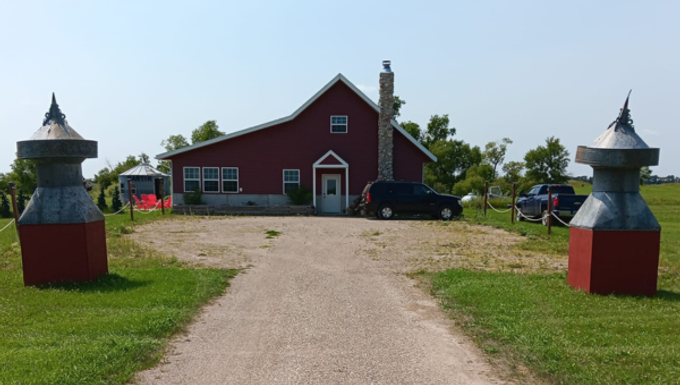
Tyler Bertsch: All right, so how did you get started into growing grapes?
Mark Vining: My dad was a winemaker. He was at the North Dakota National Guard in Fargo for 30 plus years. At the Guard, they used to have a caretaker that lived on base, and he had a wild grape arbor. My dad and a couple of his friends went and picked the wild grapes, and then they made their first ever grape wine in 1968 from those wild grapes. That was cool. That got me interested.
Then when he would take the mash and he would throw it behind the lot in Fargo and wild grapes started growing, he transplanted those down to our lake cabin. So now there's wild grapes that are at the lake cabin that came from his original 1968 wild grape wine. We're now propagating those grapevines. We're going to put them in our vineyard and we're going to make wild grape wine from the same vines that his first ever vintage was.
Tyler Bertsch: That's cool. You're going to make Jason proud too. He inspired me to plant some. I told him and he inspired me to plant some of those wild riparia cuttings.
Mark Vining: It's hard to make good wild grape wine, but Jason, he does it.
Tyler Bertsch: It's crazy. When did you first plant these out here? What was the first year the first vine went in?
Mark Vining: 2009 was our first year of planting. We put in a few dozen Frontenac and a few dozen Frontenac Gris. But most of what we planted the first year was our soil conservation plantings. It was the plums, the chokecherries, sea berries, Juneberries, Aronia berries. It just kept growing from there, but the first year was primarily berries with some Gris and a few others.
Tyler Bertsch: Was there some vines you planted that didn't make it that in hindsight looking back you wouldn't advise people to plant them?
Mark Vining: The Edelweiss is very marginally cold hardy up here. We're not planting any more Edelweiss.
Tyler Bertsch: Did you get crop off of it?
Mark Vining: No, we never have. I ignored it because it wasn't doing well, but it kept hanging on. Marquette has been strange. What we found is Marquette, the older the Marquette gets, the more susceptible it seems to be to dieback from winter kill, which is the opposite of what we expected.
So what we've done is now we grow double trunks on almost everything, especially the Marquette. We'll start a trunk and then we'll wait two or three years and start another trunk so they're not the same age. Hopefully that is insurance.
We pretty much harvest—once we start harvesting, we'll harvest all the whites first and then we'll harvest all the reds, and that happens within a compressed timeframe, within two weeks. Up here we're harvesting pretty late. Our growing degree days are marginal.
Tyler Bertsch: 120, 130 GDD?
Mark Vining: No, we're probably 150. But there's a lot of days that need to be ideal to get the acid levels down to where they should be. We're not getting our heat after the brix levels peak out, we're getting that heat early. We need that heat late to drop the acid levels. So when we're into the end of September, first part of October, there's times we're harvesting at pretty high acid levels that we just have to take the grapes. Growing degree days are a big deal up here.
Tyler Bertsch: Oh yeah. How many acres do you have?
Mark Vining: We've got about 1,20 vines in the ground right now.
Tyler Bertsch: And you just taught yourself or your dad taught you with pruning?
Mark Vining: Growing grapes was self-taught. Books and videos and a lot of mistakes. Back then there wasn't as much readily available as it is now. Lon Rombough out of Oregon had the "Growing Grapes" book. That was my go-to book for a while. Then Tom Plocher put out a softcover. But there just wasn't a lot of grape growing done up here in 2009, 2010. There weren't a lot of us crazy people at that time.
Tyler Bertsch: What was your land used for before you put the grapes in?
Mark Vining: It was a cornfield.
Tyler Bertsch: Did you have any nitrogen problems or anything from that you think?
Mark Vining: No, and I don't think it was from that. We do have in that 12 acres, there's five soil types because we're sitting on the shoreline of Lake Agassiz. The glacial lake came through here. We're on the Campbell Beach of Lake Agassiz. So we've got striations of sand and gravel.
At the very entrance to the orchard and vineyard, that production index is in the upper 40s. But if you go up into another section, probably two-thirds has a production index about 80. There's a huge swing and we can actually see that as you look at different areas of the orchard and vineyard. You can tell where the high production areas are.
Tyler Bertsch: Did you notice any—so you have La Crescent, Marquette, Frontenac—did you notice with the Marquette, did it perform better in different regions different than the other varieties did or were they all the same?
Mark Vining: It's all the same. Towards the south part of the vineyard is where the lower production index is and you can definitely see the difference in the vigor in that low PI area. We're sitting on about a foot and a half of sandy loam and then below that it's sand and gravel.
Tyler Bertsch: Do you feel like that's been beneficial to be on sandy loam? That's what they tell you is good.
Mark Vining: That's why I picked the spot. It took me almost 10 years to find this place. I wanted some decent production index on the surface, but then I wanted good drainage, especially for the grapes. We've got about a 4% grade and when we get that down below a foot, foot and a half, we hit sand and gravel which with that 4% grade, it's not drowning out the grapevines like you get in the gumbo of the Red River Valley.
Tyler Bertsch: Black soils.
Mark Vining: I was just talking with Sean and he's in the gumbo. That soil is really dark. And you get lots of vegetative growth but I don't care. I don't need vegetative growth to make wine.
Tyler Bertsch: Interesting. How many buds per spur do you usually leave?
Mark Vining: We typically try to get about—on the fully mature vines—we'll do about 40 spurs. 20 on each side. If we're running a double trunk, we're basically doing 20 each trunk.
Tyler Bertsch: Do you do two buds or three buds or one bud?
Mark Vining: In the fall we'll prune to four buds. Then in the spring after we've gotten through our last frost, then we'll go down to two buds. We typically, probably three out of four years, get a Mother's Day frost. So we don't do our final pruning until after that frost because we may lose the primary bud. Then we're down to secondary buds which is half a crop. I don't want to prune down to two buds.
Tyler Bertsch: Do you notice a difference in secondary buds on these varieties, like some of them are better than others?
Mark Vining: I don't think that the secondary buds are producing as high a quality of crop.
Tyler Bertsch: Right, but I didn't know if Marquette, let's say, or Frontenac did better, still produced more clusters than say compared to others. It happens so rare.
Mark Vining: I haven't really paid that much attention to it. Being the only one doing all the work out there, I don't have a lot of time to sit and look at it. You got to keep moving.
Tyler Bertsch: Were there some varieties that people were excited about around here that once they planted them, a lot of people said this isn't going to work?
Mark Vining: Edelweiss. I know a bunch of people planted Edelweiss up here and I love Edelweiss wine, but it's just not cold hardy enough to want to keep up here. Verona has really not been all that cold hardy up here. I really love Verona.
Tyler Bertsch: It’s good wine, it's just not hardy up here.
Mark Vining: It doesn't seem to be as cold hardy as Crimson.
Tyler Bertsch: That makes sense. Have you ever had issues with drought, like a year where it was really dry?
Mark Vining: We don't irrigate, so it's tough love up in the vineyard. Especially on sandy loam.
Tyler Bertsch: Did any of the varieties do better, handle it better than other ones?
Mark Vining: I think the Gris is probably the toughest grape we've got here.
Tyler Bertsch: That's what I heard from everybody. All you North Dakota growers have said Gris, that seems like the holy grail. Why is it different than blanc and red? Is it just epigenetics? Because genetically it should be identical because they're bud sports. It's a mutation, so I don't know. It's weird. But you guys are all telling me Frontenac Gris is better, so that's interesting.
Tyler Bertsch: Trunk diseases, did I ask you about that?
Mark Vining: I haven't seen any phylloxera here and we really don't have any issues with diseases or fungus or anything. Partially because we're in North Dakota and it's so windy and dry. It dries everything out and our canopies don't get that heavy. Especially with VSP, it helps keep the canopy open. We get a lot of breeze and it—so we don't see hardly any mildew, powdery or downy. We get a little bit of black rot, but not much.
Tyler Bertsch: What about herbicide drift? Do you get much of that?
Mark Vining: We watch that like a hawk. You just keep up with your neighbors as best you can.
Tyler Bertsch: They don't like you very much. I'm sure not. We all battle with that.
Mark Vining: Fortunately, up until this year, the person on the north side and the west side of my orchard and vineyard, the person that has been planting that rents from me. So I have control. We can't control what's across the road to the east. We can't control what's to the north of us. But all of those people now know that I watch it like a hawk and they will get a phone call. We track every spray that happens up here.
Tyler Bertsch: How do you know that? Just driving around?
Mark Vining: I watch it. And we've caught them. We've actually videotaped the aerial applications.
Tyler Bertsch: Oh they're aerial. That makes it worse.
Mark Vining: Talked to the applicator. Two years ago we had somebody applying a fungicide and a herbicide and an insecticide in the fields to the north of us with a 12-mile-an-hour north wind, which exceeded the label requirements.
It's not just glyphosate. Glyphosate on the grapes is a big issue, but I also have 2-4D and I have the orchard and the vineyard. There's some fungicides that are highly phytotoxic to apples at 30 parts per billion.
Tyler Bertsch: 30 parts per billion. I know azoxystrobin is one of them.
Mark Vining: Quadris Pro and Quilt Xcel have a chemical in them that's highly phytotoxic to apples. So we caught this person spraying that particular fungicide and insecticide and—I don't know if you noticed we have bees up here—and they sprayed the bees, they killed thousands of the bees and sickened our apples. That only happened once.
Tyler Bertsch: Do you use extension agents to deal with that?
Mark Vining: No, we go direct to the applicator and if they have a problem with that, we go right to the Ag Department. We are registered with the Ag Department. Both our location for our vineyard and orchard and the beekeeper is registered. Both of us are registered at the Ag Department.
Tyler Bertsch: In Nebraska we have a "Drift Watch." Is that part of that?
Mark Vining: I don't know if it's actually part of that, but it's similar. Like your own North Dakota version of that.
Tyler Bertsch: Which of these varieties have you think the most winter damage that you're constantly battling?
Mark Vining: Certainly Edelweiss has been a big issue. Marquette, surprisingly, has been sensitive to the dieback in the winter. Which is the opposite of what we expected. Otherwise we haven't—
Tyler Bertsch: La Crescent, how’s it do?
Mark Vining: The La Crescent's been surprisingly good. But we also haven't cropped the La Crescent very heavily. So it's got a lot of room.
Tyler Bertsch: So it can put its carbs towards winter instead of ripening grapes.
Mark Vining: Hardening off.
Tyler Bertsch: Do you do netting? Bird netting?
Mark Vining: Yes. And we have an electronic bird scarer system. And we use flash tape.
Tyler Bertsch: Do you think the flash tape works? I tried it one year, I don't know if it works.
Mark Vining: We use everything we can think of.
Tyler Bertsch: What about raccoons? They come in and grab them on VSP, those little boogers.
Mark Vining: No, actually thank God we don't have raccoons. We have had wild turkeys in there, but they tend to just disappear.
Tyler Bertsch: Just happen to jump in front of a lead bullet, right?
Mark Vining: Jay, where'd you find it? Oh we found it in the smoker.
Tyler Bertsch:The big pest that I've heard for North Dakota growers is the little Asian beetle. Horrible.
Mark Vining:The Asian Lady Beetles. We have a lot of them up here because they were brought in on purpose to eat aphids off of the soybeans. So last year we had no soybeans planted around here. The soybean market had tanked, nobody planted soybeans. So the beetles did not have any aphids to eat. They spent the summer and the fall in my orchard. They were eating my apples.
Tyler Bertsch: Really? I didn't realize they could do that. I've never seen that.
Mark Vining: They were literally eating apples. So we found them here, we found them at Underwood, Minnesota where we were getting grapes. When we picked the whites, we didn't have a big problem because they were early enough. When we picked the reds, they were full of Asian lady beetles. We were filling 50-gallon barrels with water, throwing the grapes in there, floating them, and trying to get rid of the beetles. It took us probably four to six times longer to process grapes because we were trying to get rid of beetles.
Tyler Bertsch: It’s a pain in the butt. I'm trying to see if I can figure out a better way. Talking to other people that's what they're all doing is dunking them.
Mark Vining: And it's so labor intensive. Normally we would just dump the buckets into the crusher/destemmer. We dump them into the buckets, shake the buckets, the barrels, skim them off. But if we didn't do that, we couldn't use them. That crop would be ruined.
So that's our biggest pest. SWD has been a problem in the fruits. We've had SWD for probably 10 years up here.
Tyler Bertsch: SWD?
Mark Vining: Spotted Wing Drosophila.
Tyler Bertsch: What the hell is that?
Mark Vining: It's a fruit fly. But normally fruit flies only set their eggs in damaged fruit. SWD has a little razor in its rear end that drills a hole into the fruit, sets the eggs in there, and you don't even notice it until you start washing it and then larva start coming out.
Tyler Bertsch: Oh great.
Mark Vining: It decimated the fresh fruit crop at farmers markets in Oregon and Washington because that's where it started. It came over from, I think from Japan or China.
Tyler Bertsch: It’s always China, it seems like.
Mark Vining: But it's one of those things where you don't notice it right away. People are going to buy their fruits at the farmers market, they go to wash them and all of a sudden there's little wiggly larva coming out. Hell, nobody will buy anything then.
And you can spray but it's pretty prevalent. We find them in raspberries and cherries. The softer the fruit, the more they like it. We actually found them in our Juneberries. We picked Juneberries for two days and then the SWD came in and I could smell the acetobacter.
Tyler Bertsch: Vinegar.
Mark Vining: Had to walk away. We couldn't harvest anymore.
Tyler Bertsch: That’s a bummer. Did you do any petiole testing on the grapes?
Mark Vining: We haven't, we should. We need to. I know North Dakota has a program, the Grape and Wine Association has a program. But you have to be a member of that. And Agvise up in Northwood will do the test and they're like 30 bucks or something.
Tyler Bertsch: What about fertilizer? Do you ever mess with that at all or you just let them go?
Mark Vining: We actually have not. We do a little bit of foliar, but not really a whole lot. It's been—we haven't had to.
Tyler Bertsch: Interesting, you do foliar. I haven't heard anybody really do that. Why or what do you do?
Mark Vining: We just kind of experimented with it. We were using fish.
Tyler Bertsch: Really? You got five gallons of this fish emulsion? Interesting, did it make a difference?
Mark Vining: I don't think so. Smelled terrible.
Tyler Bertsch: I was hoping you were like "Yeah it was great." I'd be like "Oh man."
Tyler Bertsch:Do you think Prairie wines can truly compete? And on what terms?
Mark Vining: Absolutely. One of the biggest issues that we have is higher acid levels. But if you take a look at European wines, most European wines have a higher acid level than California wines. In California it’s so hot that it pulls the acids out and their wines tend to get flabby. They don't have any acidity left. There's no complexity.
Ours are more like maybe high altitude Italian or Germanic wines. I kind of embrace some of that acidity. It's a matter of educating people because people are so used to drinking the super low acid California wines. But I think our customers have embraced it and I think it's just going to be a matter of time.
Tyler Bertsch: What advice would you give someone planting their first vineyard today?
Mark Vining: Do it when you're 20 years old. Don't start at 50. I started mine at 50. I'm 70 now. It's a lot of work. 20 years though, that's a lot of good experience.
If somebody wants to start growing grapes, the first thing they need to do is reach out to local growers. Not somebody 10 states away, or three or four states away. Within your own counties.
Tyler Bertsch: That's kind of why I made the region what it is on my website and talk about it because we have unique challenges. They would say cold climate, but yet Michigan is totally different and New York is totally different. All those varieties croak. But Nebraska, Iowa, Minnesota, Wisconsin, Dakotas—we share the same varieties. We have the cold desiccating winds. They get hammered by the frost.
Mark Vining:
I think we've only been at this for 20 years, 30 years. Frontenac was '96, so that was kind of the first one. When Elmer Swenson started 50 years ago in the 80s—that's peanuts when you're talking Europe thousands of years. Zinfandel and Cab go back to the Middle Ages. Even the monks in California, that's 1500s, 1600s they were doing that. We're in our infancy.
Tyler Bertsch: What are you most proud of through your years and what kept you going through the hard times? What drove you to keep doing this?
Mark Vining: Part of it was the collaboration with a lot of the other winemakers. We learn from each other, we critique each other, and it's kind of cool to be a pioneer. We're doing stuff that nobody thought we could do. People said you can't do that, and we said, "Hold my wine glass and watch me."
Now you look at what Sean's doing at Bear Creek with working with Tom Plocher and varieties. Jeff Peterson up at Point of View has already got two or three varieties that he's got a patent but he's releasing. Anybody can come and get them. There's breeders that are making huge strides.
Tyler Bertsch: It’s surprising how many breeders you guys have up here, private breeders.
Mark Vining: There's some really, really promising accessions out of NDSU Minot. We've been doing the sensory evaluations for them. We tested the reds this winter and there were probably three or four I would plant today if I could get those grapes. They were that good.
Tyler Bertsch: Last question. So you planted—correct me if I'm wrong—you have La Crescent, St. Pepin, Prairie Star, Frontenac family, the Pearl family, Itasca, and Marquette. Which ones would you not plant again?
Mark Vining: I wouldn't plant Edelweiss. I think I would probably plant all of them again.
Tyler Bertsch: Even Marquette?
Mark Vining: Oh yeah. I love Marquette. It makes such a good wine. Managed in the vineyard with the double trunks, I think it's fine. We're experimenting with Adelmina right now. Karen has Adelmina planted at her house and I've got a few of them up here. I've been aware of Adelmina before it was named. It was Swenson 61630. A friend of mine was growing it at his place in Fargo making wine out of it. He had like three vines.
Tyler Bertsch: What's it taste like? Is it like Brianna, Edelweiss, La Crescent?
Mark Vining: Brianna I would not plant. Brianna is not one we plant. I love Brianna but it's not cold hardy. Adelmina is probably a cross between maybe a La Crescent—very aromatic? Very aromatic, yeah. Brianna and La Crescent, very aromatic, almost spicy. I don't get to eat much of them because she picks them and eats them off the vine for lunch. She sits on the porch and grabs a whole bunch and they're good.
Tyler Bertsch: All right, well I don't have any more questions.
Mark Vining: All right.