The History of Dakota Viticulture
by Tyler Bertsch
Long before vineyards appeared on the northern plains, grapes were already part of the Dakota landscape. Wild riverbank grapes (Vitis riparia) grew abundantly along the Missouri, James, Sheyenne, and Red River valleys, climbing through cottonwoods and sheltering in wooded draws protected from the winds of the open prairie. These native vines had adapted to a climate that routinely produced some of the coldest temperatures in North America, surviving winters that would later destroy many cultivated grape varieties.
For Native peoples and later settlers, the wild grape was more than a curiosity. It was a useful and familiar resource. As documented by ethnobotanists like Dr. Melvin R. Gilmore, these wild vines were essential genetic reservoirs. In his field studies of the Missouri River region, Gilmore identified the wild grape—known to the Dakota as Chan wakpa (tree-twiner) and to the Omaha-Ponca as Hazi—as a significant resource. He recorded that the fruit was used for food, either fresh or dried for winter use, and noted that Pawnee harvesters occasionally tapped the thick vines in the spring to collect and drink the sap, which they described as having a pleasant, grape-juice flavor.
This broader ethnobotanical picture is reinforced by Indigenous firsthand accounts that describe the wild grape not as an abstract plant resource, but as a lived, everyday part of seasonal food and material culture. Buffalo Bird Woman, in the book Uses of Plants by the Hidatsas of the Northern Plains by Gilbert L. Wilson, provided one of the most detailed Indigenous accounts describing them as a seasonal fruit gathered along the wooded river bottoms of the Missouri. She recalled that grapes were picked by families and children when ripe, eaten fresh, and sometimes dried for later use. Beyond food, she noted a broader range of practical applications: the dark juice could be used as a dye, and the vines themselves had utility as flexible material for tying. She also remembered her father, Small Ankle, preparing a simple grape drink by crushing the fruit and mixing it with water, showing that the plant was not only gathered but actively processed in household use. While not a staple compared to chokecherries or plums, the grape was a familiar and multifunctional resource woven into seasonal life along the river
Adobe Gallery, "Indian Women Collecting Grapes from Vines in Trees," https://www.adobegallery.com/art/indian-women-collecting-grapes-from-vines-in-trees.
They possessed an innate immunity to the phylloxera and fungal diseases that devastated European vines and, more importantly, could withstand temperatures as low as -40°F.
Gilmore, M. R. (1919). Uses of Plants by the Indians of the Missouri River Region. Thirty-Third Annual Report of the Bureau of American Ethnology.
However, North Dakota’s viticultural identity was complicated by its political landscape. Entering statehood as a "dry" state in 1889, the production of wine—the traditional economic engine for grape growing—was legally stifled. This forced the state's early horticulturalists to focus on "utility fruit": grapes for jellies, unfermented juices, and fresh table use. This legal constraint ironically accelerated the search for flavor, as the high acidity of wild grapes, while manageable in fermented wine, required significant hybridizing to be palatable as a fresh fruit. Yet, the grape was far more than a mere agricultural subject for the state’s early settlers; for the region’s original inhabitants, it had already been woven into the very fabric of cosmology and survival.
The Vine as an Ontological Bridge
In the Mandan origin narrative, the people originally dwelt in a subterranean world. Their transition to the surface—the "upper world"—was facilitated by a massive grapevine root that had grown down from the earth's crust. This story serves as a powerful metaphor for the plant's ecological role. In the riparian zones of the Dakotas, the wild Vitis riparia is a dominant climber, its thick, woody trunks (often several inches in diameter) serving as a physical ladder within the forest canopy.
By centering their emergence on the grapevine, the Mandan elevated the plant to a position of sacred utility. It represented life, growth, and the connection between the dark, fertile soil and the light of the sun. Unlike European traditions that viewed the vine through the lens of Dionysian intoxication, the Mandan saw the vine as the very conduit of human existence.
Katherine Judson’s 1914 work, Myths and Legends of the Mississippi Valley and the Great Lakes,
Botanical Resiliency and the "Mother" Vine
When early 20th-century breeders like N.E. Hansen began searching for the building blocks of a northern viticulture, they were essentially "discovering" a resource that the Mandan had managed and lived alongside for centuries.
The Mandan villages were located in the very heart of the Vitis riparia’s most resilient range. These vines had survived the "Little Ice Age" and the extreme fluctuations of the northern prairie climate. The genetic vigor that breeders prized—the "ironclad" hardiness—was the same vigor that allowed the vines to grow large enough in Mandan lore to support the weight of a nation climbing toward the sun.
To understand Dakota viticulture is to recognize that the vine did not arrive with the railroad or the experimental farm; it was already there, woven into the foundational stories of the land's original inhabitants.
The Mandan emergence myth provides a necessary correction to the narrative of the "frontier." It suggests that the grape was not a crop to be "conquered" or "introduced" to a hostile environment, but a long-standing partner in human survival. In the Mandan view, the grapevine did not just belong in the North—it was the very reason humans were able to inhabit the North in the first place. This ancient perspective offers a humbling context to the work of later breeders: they were not creating something out of nothing, but rather tending to the descendants of the vine that brought the Mandan into the light. While this mythic understanding rooted the plant in the spiritual history of the plains, it also mirrored the vine’s tangible importance to the generations of settlers who followed.
Settler families gathered the fruit for preserves, juice, and homemade wine, while the vines themselves became a recognizable feature of the river bottoms. By the late nineteenth century, newspapers throughout the Dakotas regularly reported on the annual grape harvest. On September 23rd 1887, the Bismarck Weekly Tribune described abundant wild grape crops and noted the production of local wines, demonstrating that grape culture already existed in a practical form even before commercial viticulture had taken hold.
The success of these native vines raised an important question. If grapes could survive naturally in the Dakotas, why couldn't cultivated varieties do the same?
As settlement expanded across the region, growers began experimenting with grapes that had proven successful farther east. Concord, Delaware, and other established varieties were planted in farmyards, gardens, and small vineyards. Results were encouraging during the growing season. Ambitious growers began attempting to cultivate domestic varieties. In Jamestown, ND early growers like G.W. Newton experimented with varieties such as the Concord and Delaware. However, these early efforts revealed the central challenge of Dakota viticulture: winter survival. These domestic vines required intensive labor, including being "laid down" and covered with earth or mulch to survive the harsh winters (Jamestown Weekly Alert, May 2, 1889).
The Dakotas possessed something many eastern grape-growing regions lacked: abundant summer sunshine. Advocates argued that northern latitudes provided exceptionally long daylight hours during the growing season, allowing grapes to ripen despite the short season. Writing on January 8th 1891, the Dakota Farmers' Leader observed that successful grape growing depended more upon heat summation than mild winters and suggested that grapes were entirely possible in Dakota if growers could overcome the challenge of winter injury.
Winter remained the great obstacle. While native Vitis riparia survived naturally, cultivated grapes often suffered severe damage or complete death when left exposed. Growers soon developed a laborious solution. Each autumn, the vines were removed from their trellises, laid on the ground, and covered with soil before winter arrived. In spring, they were uncovered, lifted, and retrained. The Jamestown news article in 1889 also described this practice as essential for the successful cultivation of eastern varieties. The method worked, but it limited viticulture to determined hobbyists and dedicated fruit growers.
Yet optimism persisted. Agricultural writers increasingly pointed to successful vineyards as evidence that the Dakotas were not inherently hostile to grape growing. Displays at county fairs and state exhibitions reinforced this belief. By the opening years of the twentieth century, grapes were being exhibited successfully in communities stretching well into northern South Dakota. Visitors to the South Dakota State Fair in 1906 found displays featuring several grape varieties grown as far north as Huron. Writing afterward in the Aberdeen Democrat, George B. Daly remarked that some of the grapes compared favorably with the best Concords produced in New York and Ohio.
Still, every success carried the same qualification: winter protection. The best eastern varieties could produce excellent fruit, but they demanded annual labor to survive. A shift toward a more scientific approach to grape growing, led largely by Professor C.B. Waldron at the North Dakota Agricultural College. Waldron and his colleagues recognized that for viticulture to be viable for the average farmer, a grape had to be found—or bred—that did not require the laborious process of winter covering.
In 1905, the Agricultural College in North Dakota was actively testing varieties that could withstand temperatures of 40 degrees below zero. Professor Waldron emphasized that the goal was to identify grapes that were "perfectly hardy," meaning they could remain on the trellis year-round (Fargo Forum and Daily Republican, November 24, 1905). This academic oversight provided the credibility and data necessary to encourage farmers to plant small trial vineyards across the state.
For viticulture to become something more than a backyard pursuit, growers needed a grape that could withstand Dakota winters without burial.
That breakthrough was about to arrive.
Part II: The Beta Revolution
US Dept of Agriculture
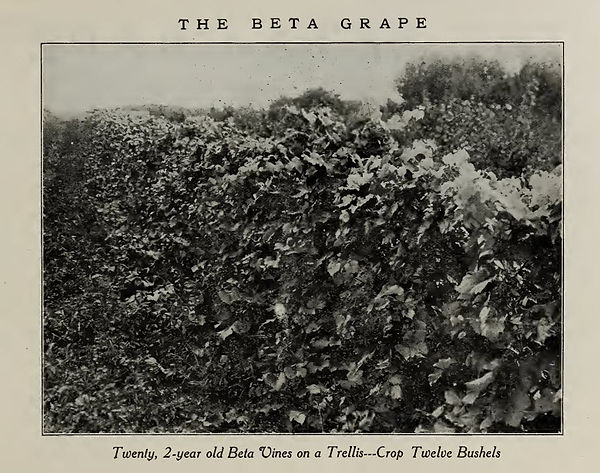
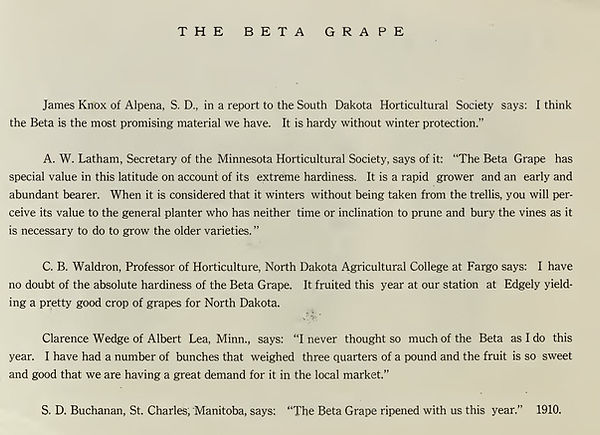
Sherman Nursery Co. (1910). Beta, the new grape. Sherman Nursery Co. https://upload.wikimedia.org/wikipedia/commons/8/89/Beta%2C_the_new_grape_%28IA_CAT31293146%29.pdf
The search for a grape capable of surviving Dakota winters without protection became one of the most important challenges facing northern horticulture. Growers understood that the future of the industry depended not on producing better fruit, but on producing a hardier vine.
The answer emerged in the form of the Beta grape, a hybrid cross between Concord and a wild riparia selection, developed by Minnesota viticulturist Louis Suelter in 1881. Drawing upon the rugged hardiness of the native riverbank grape (Vitis riparia), Beta possessed a characteristic that immediately distinguished it from the Concord and other popular eastern varieties: it could survive the northern plains winter while remaining on the trellis.
Sherman Nursery Co. (1910). Beta, the new grape. Sherman Nursery Co. https://upload.wikimedia.org/wikipedia/commons/8/89/Beta%2C_the_new_grape_%28IA_CAT31293146%29.pdf
Its arrival into the Dakotas at the turn of the century represented more than the introduction of a new cultivar. It fundamentally changed how growers thought about viticulture in the Dakotas.
Reporting on exhibits at the State Fair, George B. Daly noted that residents of Brown County could successfully grow Concord, Janesville, and Beta grapes, but he singled out Beta for special praise. Unlike the other varieties, which still required winter covering, Beta was described as exceptionally hardy and capable of surviving without protection. Its fruit was somewhat smaller than Concord, but its ability to endure Dakota winters without burial made it uniquely valuable to growers. The distinction was significant. For the first time, a grape existed that offered a realistic path toward practical vineyard production on the northern prairie.
Sherman Nursery Co. (1910). Beta, the new grape. Sherman Nursery Co. https://upload.wikimedia.org/wikipedia/commons/8/89/Beta%2C_the_new_grape_%28IA_CAT31293146%29.pdf
The impact of Beta spread quickly across both states. Agricultural educators and experiment stations increasingly recommended it to farmers seeking dependable fruit crops. In North Dakota, the variety moved from experimental plantings into broader cultivation.
Sherman Nursery Co. (1910). Beta, the new grape. Sherman Nursery Co. https://upload.wikimedia.org/wikipedia/commons/8/89/Beta%2C_the_new_grape_%28IA_CAT31293146%29.pdf
We have many different news articles from the early 1900s showing how transformative the Beta grape was for aspiring grape growers throughout the Dakotas as it’s adoption grew:
It was described as "extremely hardy," capable of surviving the most severe winters without any protection (Grand Forks Evening Times, March 31, 1906).
Experts touted it as the only variety that the average farmer could plant with a guarantee of success, noting that it was a prolific bearer and ideal for jelly and juice (Bismarck Daily Tribune, March 12, 1907).
Vineyards began to appear in unexpected places, including the outskirts of Bismarck, where growers successfully produced excellent fruit(Bismarck Daily Tribune, September 10, 1907).
The Beta had become the standard-bearer for the region. Agricultural reports from that year solidified its reputation as the "only grape that will stand the winter" in the Dakotas without being buried in the soil (Jamestown Weekly Alert, September 30, 1909).
The North Dakota Agricultural College’s recommendations had taken firm root. The Beta grape was no longer merely an experiment; it was recognized as a "perfectly hardy" variety that could produce fruit reliably even under the most trying conditions of the Northern Plains (The Ward County Independent, September 18, 1913).
1914, success stories began to emerge from across the state. In Grand Forks, local growers like W.P. Davies demonstrated that the Beta could produce a "splendid" and heavy crop, further proving that the variety was well-suited to the Red River Valley’s soil and climate (Grand Forks Evening Times, August 29, 1914).
That same year, agricultural reports in the central part of the state confirmed that the Beta was "proving its worth" to farmers who had previously struggled with less hardy varieties (Jamestown Weekly Alert, August 20, 1914).
The Beta had reached a status of near-unanimous endorsement by state experts. In comprehensive horticultural guides published in the state’s leading newspapers, the Beta was listed as the premier recommendation for any North Dakota farmer looking to establish a vineyard. Its primary selling point remained its "heavy yielding" nature and its ability to survive the winter without being "laid down" or covered, a labor-saving characteristic that made viticulture accessible to the general public (The Fargo Forum and Daily Republican, February 2, 1917).
Growers who had spent years struggling with winter-killed vines suddenly had access to a grape that could survive the climate largely on its own.
Success stories soon followed. In Grand Forks, growers reported heavy and productive crops, while central North Dakota newspapers noted that the variety was steadily proving its value to farmers. What made Beta remarkable was not merely its survival but its consistency. It fruited reliably, yielded heavily, and eliminated one of the most labor-intensive tasks associated with grape growing. For ordinary farm families, this transformed viticulture from a specialized hobby into a semi-realistic agricultural pursuit. Beta had become the standard against which other grapes were measured.
Another significant development in this era was also the introduction and promotion of the Alpha grape. Much like the Beta, the Alpha, another Louis Suelter grape, was a hardy hybrid designed specifically for northern climates. The Alpha was being touted as a formidable companion—or even a rival—to the Beta.
Horticulturalists described the Alpha as a vigorous grower that was "perfectly hardy" in the Northwest. It was noted for its ability to produce heavy crops of high-quality fruit, further expanding the options for North Dakota growers who required vines that could survive temperatures that would kill more temperate varieties. The Alpha and Beta together formed the "iron-clad" duo that defined the state's domestic small scale production during this period.
While cultivated varieties like the Beta and Alpha gained ground, the state’s wild grapes (Vitis riparia) still remained a massive natural resource, particularly in the river valleys. The Sheyenne and Missouri rivers provided a bounty that residents continued to harvest for domestic use. In 1917, reports from Valley City highlighted an "exceptionally large" crop of wild grapes, which were eagerly gathered for the production of preserves and wine (The Weekly Times-Record, September 7, 1917).
This reliance on wild fruit continued through the end of the decade. In 1920, the Missouri River bottoms near Bismarck were described as being "laden" with wild grapes. These were not merely seen as a forage crop but as a staple for local households, with families traveling to the riverbanks to collect them for their "winter’s supply" of juice and homemade wine (Bismarck Daily Tribune, October 2, 1920)
The newspapers of this era also reveal a keen public interest in the phenology of the vine. Reports meticulously tracked when the wild grapes were in bloom—usually in late June—as a marker of the growing season’s progress (Bismarck Daily Tribune, June 30, 1919). Even as winter approached, the resilience of the grape was noted; wild grapes were often still being discussed or harvested in late autumn, showing their ability to withstand early autumn freezes that would kill off more tender fruits (Bismarck Daily Tribune, November 3, 1920).
In the 1920s and into the mid-1930s, North Dakota viticulture transitioned from a period of discovery to one of refinement. As the state navigated the economic and environmental challenges of the Great Depression and the Dust Bowl, the reliance on "iron-clad" grape varieties became a matter of agricultural necessity rather than just a horticultural preference.
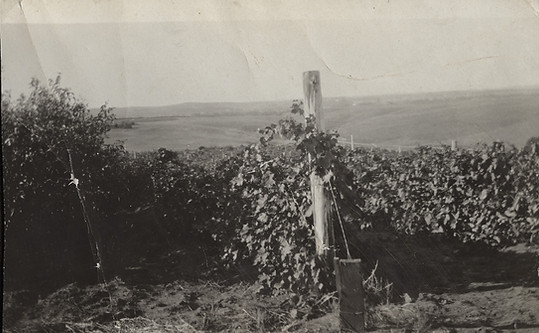
"Grape vines at Experiment Station, Mandan (N.D.)," July 1923, State Historical Society of North Dakota, Collection 00207, Folder 0001, Item 00006.
While early agricultural bulletins documented the success of hardy varieties in text, physical evidence of these early vineyards remains rare. A photograph from 1923 offers a unique glimpse into the functional reality of these experimental plots at the federal research station in Mandan, North Dakota.
The image depicts a simple, rugged trellis system—a stark contrast to the sprawling vineyards of more temperate climates. This modest configuration, captured during the transition toward standardized hardy hybrids, serves as a testament to the practical, no-frills approach required by Northern Prairie horticulturists. Rather than prioritizing aesthetics or commercial scale, the Mandan station focused on the essential goal of the era: proving that a vine could survive, fruit, and thrive on the open, windswept prairies without the need for human-provided winter protection.
Pfaender, Max. "The City Beautiful." North and South Dakota Horticulture, vol. 3, no. 4, April 1931, p. 58. https://openprairie.sdstate.edu/ndsh/10/
Max Pfaender stands as a pivotal figure in the transition of Northern Plains horticulture from speculative frontier trials to a disciplined, scientific system. Born in 1885 into the prominent Pfaender family of New Ulm, Minnesota—a town synonymous with early Midwestern nursery work—he inherited a legacy of botanical curiosity that he eventually applied to the specific environmental rigors of North Dakota. His most influential work began in 1912 when he was appointed as a horticulturist at the Northern Great Plains Field Station in Mandan, North Dakota. At this newly established federal research site, Pfaender faced the daunting task of identifying fruit varieties that could withstand the erratic temperature swings and desiccating winds characteristic of the Missouri River Valley.
In the realm of viticulture, Pfaender’s contribution was less about the creation of new genetic crosses and more about the rigorous standardization of existing hardy stock. During a period when the "Beta" grape was often sold under various names or confused with inferior seedlings, Pfaender conducted exhaustive variety trials to verify the hardiness and productivity of the Suelter and Hansen hybrids.
He recognized that for a grape industry to survive in North Dakota, the "ironclad" nature of the vine had to be absolute. His research at Mandan provided the first truly reliable data on which varieties did not require the labor-intensive practice of winter burial. Furthermore, Pfaender’s background in forestry enabled him to view the vineyard as a sheltered ecosystem; he was among the first to systematically document the necessity of shelterbelts and windbreaks as prerequisites for successful viticulture on the open prairie.
Source: U.S. Department of Agriculture (1912–1920): Report of the Northern Great Plains Field Station, Mandan, North Dakota. These annual reports detail Pfaender’s specific variety trials and the development of the fruit-testing blocks.
Pfaender’s influence extended beyond the research station through his prolific writing and leadership within regional horticultural societies. During the 1910s and 1920s, his bulletins and lectures served as the primary technical guides for farmers throughout the Dakotas. He was a vocal proponent of the "Home Orchard" and "Home Vineyard" movements, framing the cultivation of hardy grapes not just as a commercial venture, but as an essential component of a stable and permanent rural civilization. By the time he transitioned into private nursery work and later into landscape architecture, Pfaender had effectively codified the rules for Northern viticulture, proving that through proper variety selection and wind protection, the Great Plains could produce consistent yields of fruit.
Source: North Dakota State Horticultural Society: Annual Reports (1914–1936). These archives contain multiple papers presented by Pfaender on the subjects of shelterbelts, hardy grapes (specifically the Beta and Alpha), and the beautification of Northern homesteads.
The growing confidence surrounding grapes was reflected in broader public discussions about the future of Dakota agriculture. The Black Hills Union and Western Stock Review argued that South Dakota should eventually grow grapes for export. The paper pointed to the region's history of abundant wild grape harvests and noted that experienced nursery operators believed the combination of plentiful spring moisture and dry autumn weather created ideal conditions for grape culture. Such optimism would have seemed unrealistic only a generation earlier. Now, with varieties like Beta demonstrating that winter hardiness was achievable, commercial possibilities no longer appeared out of reach. Varieties like the Alpha and the Dakota soon followed, providing a diverse palette of hardy stock that proved the Great Plains were not a "fruit desert," but a viable frontier for specialized horticulture.
Yet even as Beta transformed northern viticulture, it also exposed a new reality. The grape solved the problem of survival, but it did not represent the final answer. Growers still desired larger fruit, improved flavor, greater sugar content, and vines capable of thriving under even harsher conditions. Beta had proven that hardiness was possible. The next challenge was to push the boundaries even further.
That challenge would draw the attention of a young horticulturist at Brookings, South Dakota, who believed the solution might be found not in the vineyards of Europe or the orchards of the eastern United States, but in the frozen landscapes of Siberia, and northern Asia.
His name was Niels Ebbesen Hansen.
Niels Ebbesen Hansen
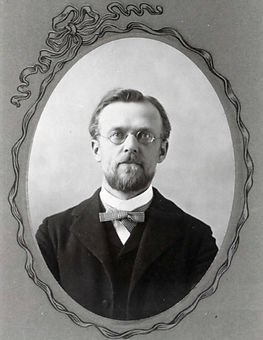
A photo of a young N.E. Hansen
"Young N.E. Hansen," n.d. N.E. Hansen Collection. South Dakota State University Archives and Special Collections, Hilton M. Briggs Library. https://openprairie.sdstate.edu/dc_Hansen/151/
Niels Ebbesen Hansen stands as one of the most consequential figures in the development of northern horticulture, especially in shaping the possibilities of viticulture across the northern prairies. While he is often remembered for introducing hardy alfalfa, wheatgrasses, plums, and shelterbelt species that transformed prairie agriculture, his influence on cold-climate grape growing is just as foundational. His life reflects a sustained effort to expand the geographic limits of agriculture itself, pushing cultivation into regions once thought too harsh for perennial fruit production.
Hansen was born in 1866 near Ribe, Denmark, into a rural environment where survival depended on close observation of land and weather. That early exposure fostered in him a lasting fascination with plants and their relationship to climate. In 1873, at just seven years old, he immigrated with his family to the United States, eventually settling in Iowa. The open prairie landscapes of his youth became the backdrop for his developing interest in agriculture, particularly the question of how plants might be adapted to survive in extreme environments.
Seeking to turn curiosity into scientific training, Hansen enrolled at Iowa State Agricultural College (now Iowa State University) in Ames. There he studied under the influential horticulturist Joseph L. Budd, who helped shape Hansen’s early thinking about plant variation, adaptation, drought resistance, and hybridization. Hansen completed his Bachelor of Science in 1887 and later returned to earn a Master of Science in 1895, establishing himself as one of the most promising young agricultural scientists in the region.
Long before his famous plant-hunting expeditions, Hansen grounded his education in hands-on horticultural practice. After his undergraduate studies, he worked for Silas Wilson at a commercial grape nursery near Atlantic, Iowa. (With a Brush and Mulin Bag) This period proved critical to his development. In Wilson’s nursery, Hansen learned the practical realities of propagating vines, managing vineyards, and testing grape and fruit varieties under Midwestern conditions. He saw directly the limits of nineteenth-century viticulture: many Eastern and European grape varieties that performed well in milder climates consistently failed as cultivation pushed westward and northward into colder, more volatile environments. These experiences sharpened a central question that would guide his entire career—what genetic traits would be necessary for grapes, apples, plums, pears etc. to survive the brutal winters of the northern plains?
In 1895, the same year he completed his master’s degree, Hansen moved north to Brookings, South Dakota, where he became head of the Department of Horticulture and Forestry at South Dakota Agricultural College (now South Dakota State University), as well as an investigator with the Agricultural Experiment Station. When he arrived, the state’s agricultural foundation was still young. Wheat and livestock had taken hold, but fruit growing remained unreliable and often discouraging. The northern prairie presented a set of environmental extremes that most eastern horticulturists had little experience with: winter temperatures routinely plunged below 30 degrees below zero, and even more damaging were the wild temperature swings that could stress or kill dormant plants. Dry, biting winds stripped moisture from plant tissues, while erratic spring freezes frequently destroyed blossoms just as they emerged. Entire orchards and vineyards could be lost in a single severe season.
Hansen concluded that the problem could not be solved by simply improving cultivation techniques or protecting existing varieties. The genetic foundation itself was inadequate for the climate. His solution was not to shield fragile plants but to seek or develop plant material inherently adapted to extreme cold and environmental stress.
This conviction ultimately shaped his most ambitious intellectual leap: the idea that if agriculture was to succeed on the northern prairie, it would need entirely new genetic stock drawn from climates of equal or greater severity. The question of grapes became particularly important in this vision. European wine grapes, descended from Vitis vinifera, had produced the world’s classic wine traditions for millennia, but they consistently failed in the northern Midwest. Even the hardier eastern North American grapes could not reliably withstand prairie winters. The climates of Bordeaux, Burgundy, and the Rhine Valley were fundamentally different from those of Dakotas, Nebraska, Iowa, and Minnesota. As a result, many horticulturists concluded that commercial viticulture in these northern regions was simply impossible.
Hansen rejected that conclusion. Instead, he reframed the problem geographically and climatically. If grapes could not survive in the northern plains using existing varieties, then the answer must lie in finding grapes adapted to climates of similar harshness elsewhere in the world. This reasoning led him to one of the most significant ideas in American horticulture at the time: the search for cold-adapted plant material in regions such as northern Russia, Siberia, Manchuria, and Turkestan.
He began systematically studying these regions and recognized striking parallels between their climates and those of the northern prairie. Both endured severe winters, periodic drought, short growing seasons, and unpredictable seasonal transitions. For Hansen, this was the key insight: survival in one extreme environment suggested the possibility of survival in another, even halfway across the world.
The First Great Expedition: Russia and Siberia, 1897
In 1897, Niels Ebbesen Hansen embarked on a nine-month, 2,000-mile journey across the vast, unforgiving expanses of Russia, Siberia, and Turkestan. Commissioned by the United States Department of Agriculture as the nation’s first official plant explorer, Hansen’s mission was to hunt for extreme cold-hardy flora that could survive the punishing climate of the Dakotas. While history textbooks often sanitize scientific exploration as an academic exercise, Hansen’s 1897 expedition was a gritty, high-stakes epic. For northern viticulture, the lineage of today’s cold-hardy grapes was written not in a cozy laboratory, but through a harrowing winter survival story that nearly cost the professor his life.
"N.E. Hansen with a group of people," n.d. Source: N.E. Hansen Collection, South Dakota State University Archives and Special Collections, Hilton M. Briggs Library. https://openprairie.sdstate.edu/dc_Hansen/150/
The wild reality of the 1897 trip lay in Hansen’s sheer disregard for his own safety in the pursuit of wild genetics. Navigating the semi-autonomous regions of Turkestan (modern-day Uzbekistan), Hansen walked straight into a geopolitical powder keg. The territory was simmering with violent anti-Russian and anti-foreign colonial uprisings. To secure unique agricultural variants—including early Eurasian grape specimens and foundational alfalfas—Hansen had to rely on midnight packing sessions, local bribes, and covert transportation networks, narrowly escaping regional capitals just before revolutionary forces and riots severed communication with the outside world.
However, the true climax of the expedition occurred when Hansen completely underestimated the savage speed of the Siberian winter. Deep in the wilderness, a massive, sub-zero blizzard slammed the region, freezing rivers solid and halting normal transit. Stranded thousands of miles from safety, Hansen refused to abandon the massive collection of wild seeds, plant cuttings, and hardy genotypes he had painstakingly gathered.
Desperate to keep his botanical cargo from freezing to death, Hansen chartered a troika—a primitive, open-toed Russian horse-drawn sleigh—and initiated a frantic, 2,000-mile race across the frozen, barren tundra toward the nearest railhead. The gamble proved nearly fatal. Speeding through the whiteout conditions, the sleigh struck a massive snowdrift and violently flipped. Hansen was thrown forcefully into the freezing drifts, sustaining severe physical injuries and immediately contracting a blistering case of pneumonia.
Stranded in a desolate, howling wasteland with no medical care, his team dragged his semi-conscious, half-frozen body to a remote, primitive Siberian outpost. Hansen spent a harrowing night hovering between life and death on the dirt floor of a crowded shelter, yet he fiercely forbade his team from abandoning the plant crates. He survived the night, crawled back into the sleigh, and successfully delivered his cargo to the trans-Siberian line.
While Hansen most likely encountered wild Vitis amurensis lines on this trek, the actual cultivated grape cargo he managed to pull out of Tashkent consisted of roughly 500 domestic Vitis vinifera lines. Back in the experimental plots of South Dakota, these European varieties completely lacked the genetic architecture to handle the brutal open-air winters and froze to death. This early failure proved to Hansen that merely importing domesticated northern stock was a dead end, sparking a decades-long obsession to return to the Far East and capture the pure, wild genetics of the ice-hardy Amur grape.
The 1906 Expedition: Surveillance, Politics, and Discovery
In 1906, Niels Ebbesen Hansen plunged back into the vast interior of the Russian Empire for his second great agricultural expedition. If his first journey in 1897 was a desperate race against the clock and the elements, the 1906 trek was a masterclass in psychological endurance, cultural immersion, and high-stakes navigating of a crumbling empire. Commissioned by the United States Department of Agriculture to find a forage crop capable of saving the Great Plains cattle industry, Hansen’s focus shifted to tracking down the near-mythical Siberian Yellow-Flowered Alfalfa (Medicago falcata). The reality of this journey, however, read less like a botanical index and more like a frontier spy thriller, complete with unexpected romance, imperial surveillance, and a high-stakes hunt through the Siberian underworld.
The true, unvarnished drama of the 1906 expedition began against a backdrop of deep personal loneliness and an explosive geopolitical landscape. Hansen, a grieving widower whose first wife had died a few years prior, was navigating the remote outpost of Omsk when a delayed bundle of mail caught up to him. Among the letters were notes from his late wife’s younger sister, Dora Pammel. Overwhelmed by isolation on the desolate frontier, Hansen wrote back a passionate, surprise marriage proposal, casting his fate to the primitive postal networks. For the remainder of the grueling expedition, Hansen tracked wild plants through mudslides and treacherous terrain with his heart on his sleeve, entirely unsure if he would return to a bride or a rejection.
Simultaneously, Hansen had to survive a highly volatile political powder keg. Russia had just suffered a humiliating defeat in the Russo-Japanese War, and the interior was rocked by peasant revolts, labor strikes, and deep anti-foreign paranoia. To the Tsar’s secret police, a lone American academic mapping out remote Siberian railroad towns and interacting with rural populations looked distinctly like a foreign spy. Hansen’s journals reveal the suffocating weight of constant surveillance; he was tracked by imperial agents, intercepted by local governors, and frequently forced to deploy a combination of academic charm and heavy financial bribes to keep his expedition from being permanently derailed by an arrest.
To secure his prize, Hansen abandoned the relative safety of Russian towns and embedded himself entirely with the nomadic ethnic tribes of the Siberian steppes. He traded Victorian comforts for a life on the dirt floors of lice-infested tents, sustaining himself on boiled horse meat and sour, fermented mare’s milk (koumiss), all while evading heavily armed roaming bandits who ruled the lawless spaces between outposts.
His reckless gamble paid off when he encountered a natural hybrid cross between blue and yellow-flowered alfalfas. He managed to barter with local nomads for a tiny, precious handful of this resilient seed—a quantity so small it amounted to a mere "teaspoon of gold" carried safely in his vest pocket across thousands of miles. This single collection became "Cossack" Alfalfa, a crop that single-handedly revolutionized the multi-million dollar livestock industry of the American West by providing an indestructible, sub-zero forage.
Though alfalfa was the crown jewel of the 1906 trip, the expedition fundamentally shaped Hansen's approach to northern viticulture. By watching wild flora thrive in the absolute worst alkaline, drought-stricken, and frozen soils of the Siberian steppes, Hansen returned to South Dakota with a ruthless new philosophy. He realized that to build a true northern grape, he could not coddle his plants. He applied this exact "steppe survival" blueprint to his future breeding blocks in Brookings, intentionally exposing his hybrid grape seedlings to freezing, unprotected Dakota winters. The wild grit required to survive the 1906 expedition became the exact genetic grit Hansen demanded of his vines, cementing a legacy where American agriculture was permanently rewritten by a handful of seeds smuggled out of the Siberian wilderness.
During his First (1897) and Second (1906) expeditions, grapes were a secondary thought. His primary missions were alfalfa, brome grass, and melons. He did pull about 500 cultivated grapevine samples out of Tashkent (Turkestan) during the first trip, but these were Vitis vinifera (domesticated wine grapes) that ultimately couldn't handle the brutal open-air winters of South Dakota.
The Third Expedition: The Rogue Budget Rebellion (1908)
By 1908, Niels Hansen was no longer just an eccentric professor from South Dakota; he was a global celebrity in the agricultural world. His previous two trips had proven that the Eurasian steppes held the genetic key to progressing American farming. But Hansen was also growing increasingly impatient. He was convinced that he had only scratched the surface of the Siberian wilderness, and he wanted to go back to gather mass commercial quantities of the yellow-flowered alfalfa he had discovered in 1906.
The scandalous, dramatic reality of this third trip actually started before he even left American soil: Hansen essentially went rogue.
1. The Budget Rebellion and Getting Fired
Hansen was a brilliant scientist, but he was a terrible bureaucrat. He utterly despised the red tape of Washington, D.C. For the 1908 trip, the USDA gave him a strict, conservative budget. Hansen completely ignored it. He traveled deep into Siberia, hiring massive crews of local peasants to harvest hundreds of pounds of wild seeds, running up bills that far exceeded what the government had authorized.
When USDA officials back in Washington saw the financial ledger, they were furious. They accused Hansen of insubordination and financial recklessness. Bureaucrats successfully persuaded the Secretary of Agriculture to drop Hansen from the official roster of active federal plant explorers. He had gotten his seeds, but he had effectively burned his bridge with the United States government. (Ever the smooth talker, Hansen simply bypassed Washington on his later trips and convinced the South Dakota State Legislature to fund his travels directly).
2. The Steppe Robbery and the Power of the Tsar
The most intense moment of the 1908 journey occurred deep in the lawless wilderness of the Russian steppes. Hansen was traveling through a remote region with a local peasant guide he had hired to navigate the vast distances.
Isolated miles from civilization, the guide realized Hansen was a wealthy foreigner carrying a significant amount of travel cash and valuable equipment. The guide cornered Hansen, attempting to rob him and abandon him in the wilderness—a fate that would have meant certain death.
Hansen didn't panic. Instead of pulling a weapon, he reached into his coat and pulled out an official, heavy parchment document: a special travel permit bearing the massive, ornate Imperial Seal of the Russian Tsar.
The effect was instantaneous and staggering. In 1908, the Romanov autocracy ruled Russia with an iron fist, and the peasant guide recognized the emperor's seal immediately. Realizing that harming Hansen meant incurring the direct, wrathful vengeance of the Tsar's army, the guide's criminal bravado collapsed. The terrified man dropped to his knees in the dirt, crossed himself, begged Hansen for mercy, and promised to fulfill his duties faithfully for the rest of the trip.
The Amur Breakthrough: Niels Hansen’s 1924 Expedition
By 1924, Niels Ebbesen Hansen had already secured his place in history as the "Alfalfa King" of the Great Plains. His dangerous treks across the Siberian tundra in 1897 and 1906 had successfully introduced sub-zero forage crops that revolutionized American livestock ranching. Yet, back at his research station in Brookings, South Dakota, one profound crop was missing: the grape. For nearly three decades, Hansen had imported domestic and European grapevines, only to watch them repeatedly freeze to death under the relentless bludgeon of Dakota winters.
The American West could grow cattle, but it could not grow high quality wine or table grapes on a consistent basis.
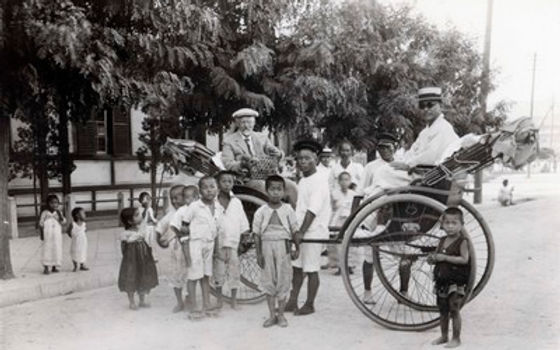
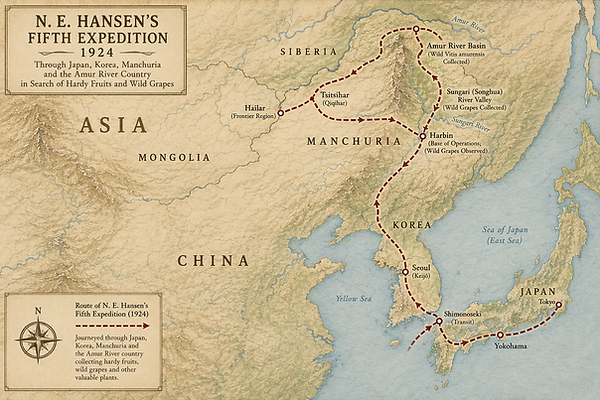
The 1924 expedition was uniquely laser-focused. Leaving behind his previous routes through central Russia, Hansen turned his sights farther east, embarking on a sweeping, grueling journey through Japan, into Seoul (Korea), and ultimately deep into the mountainous wilderness of North-Northeast China and Eastern Siberia.
"N.E. Hansen in a rickshaw in northern China in 1924." N.E. Hansen Collection, South Dakota State University Archives and Special Collections, Hilton M. Briggs Library. https://openprairie.sdstate.edu/dc_Hansen/84/
Hansen had developed a radical theory: if he wanted a grape capable of surviving a northern prairie winter without the labor-intensive practice of being buried in soil or straw, he had to find a grape that had evolved in an ecosystem even more hostile than South Dakota.
He found his biological supposed holy grail along the freezing waters of the Sungari and Amur River valleys, a region straddling the heavily forested, mountain borders of China and Siberia. There, growing wild in the mountains where winter temperatures routinely cratered past -50 degree Fahrenheit, Hansen discovered Vitis amurensis—the Amur Grape.
"Where Siberia, China and Mongolia meet, I made a rough mountain climbing tour... The trip was in a region infected with Chinese bandits, so I had to hire extra men to help me in the mountains. The peach and almond [and wild grapes] grow under severe winter conditions, at least fifty degrees below zero in winter."
The discovery was a revelation. Unlike the standard American Vitis labrusca (like the Concord) or the fragile European Vitis vinifera, the Amur Grape possessed a cellular structure that practically acted as natural antifreeze. It didn't just tolerate the cold; it required the cold to thrive. Hansen saw the wild, black-berried vines scaled forest trees, completely unprotected, surviving in soil that remained frozen solid for months on end.
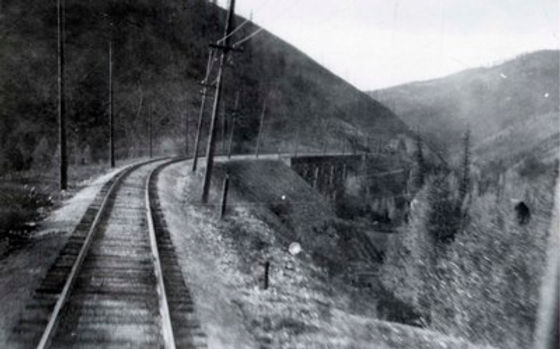
The chaotic reality of this 1924 trip lay in the sheer urgency of the harvest. Hansen was now an aging scientist, yet he dragged himself through dense, mountainous terrain, racing against the onset of yet another early northern winter. The 1924 expedition into the mountain regions of North-Northeast China (Manchuria) and the Amur River basin was an absolute nightmare of warlord violence, ruthless bandits, and public executions.
"Mountain scenery on the Trans-Siberian Railway at Saolin in northern China in 1924." N.E. Hansen Collection, South Dakota State University Archives and Special Collections, Hilton M. Briggs Library. https://openprairie.sdstate.edu/dc_Hansen/76/
When Hansen arrived in Harbin and the Sungari River valley in 1924, he didn’t just walk into a dense forest—he walked straight into the bloody chaos of the Chinese Warlord Era and the territory of the Hung Hutzers (Red Beards).
The raw, unvarnished insanity of this trip reveals a harrowing environment that Hansen had to navigate just to secure his grapes:
1. The Execution Fields of Harbin
To get to the wild Vitis amurensis vines, Hansen had to base his operations out of Harbin, a city that was a volatile powder keg overflowing with desperate Russian refugees fleeing the Bolsheviks, Chinese military factions, and lethal criminal gangs.
The local warlord governments maintained control through sheer, terrifying brutality. Hansen's journals and family records note that public executions were a routine, daily occurrence along the roadsides and city squares. Bandits, political dissidents, and thieves were regularly beheaded or shot in plain view, their bodies left exposed as a warning to others. Hansen literally had to walk past these gruesome scenes just to arrange transport, secure supplies, and buy train tickets into the mountains.
"Men selling wild grapes by the Trans-Siberian Railway by Harbin, China, 1924." N.E. Hansen Collection, South Dakota State University Archives and Special Collections, Hilton M. Briggs Library. https://openprairie.sdstate.edu/dc_Hansen/18/
The mountains surrounding the Sungari River where the best wild grapes grew were completely ruled by the Hung Hutzers. These weren't petty pickpockets; they were heavily armed, organized guerrilla bandits known for absolute ruthlessness. They routinely ambushed trains, raided rural villages, and held foreigners for massive ransoms. If a ransom wasn't paid quickly, they were notorious for sending parts of the hostage back to their family piece by piece.
Because the Chinese Civil War was fracturing the region's military, the local authorities couldn't guarantee Hansen's safety. To venture into the mountains, Hansen had to hire his own private, heavily armed guards and travel under the constant terror that a single rustle in the brush could mean a bloody ambush. He was an older man at this point, hiking through deep ravines, gathering grape cuttings while his armed escort kept their rifles trained on the treeline.
Hansen’s timing was terrifyingly narrow. Just as he was successfully pack-crating his newly discovered wild Amur grape cuttings in the mountains, the regional political instability collapsed into an all-out shooting war. Rail lines were suddenly seized by warlord armies, communication lines were sliced, and foreign nationals were desperately fleeing the interior.
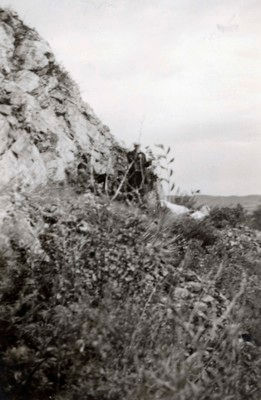
"N.E. Hansen and two assistants gather specimens in their search for hardy peach trees in northern China, 1924." Source: N.E. Hansen Collection, South Dakota State University Archives and Special Collections, Hilton M. Briggs Library. https://openprairie.sdstate.edu/dc_Hansen/58/
Hansen’s exit from Manchuria was a frantic scramble. He had to push his way onto chaotic, overcrowded evacuation trains, desperately hoarding his crates of live grape cuttings and seeds like a madman while soldiers and fleeing refugees fought for space around him. He managed to slip out of the region and catch a steamer ship back across the Pacific just as the war completely closed the borders.
Yet, the chaos of his departure was soon overshadowed by the magnitude of what he brought back to the United States. His arrival in South Dakota marked the culmination of decades of search, transforming his precarious botanical cargo into a definitive milestone for American horticulture.
In late 1924, capitalizing on the momentum of his triumphant return, the South Dakota Experiment Station officially announced the release of Hansen's historic 32 "Prairie Hybrid" grapes which were crossed back in 1895. Named after the indigenous tribes and regional landmarks of the prairie—such as Mandan, Arikara, Eona, and Chontay.
Behind this breakthrough had laid years of rigorous, often isolating, laboratory work. In his official agricultural bulletins—most notably Bulletin 237—Hansen provided a candid account of his process, contrasting the celebrated traditions of European Vitis vinifera with the harsh, unforgiving realities of the Northern Plains. Hansen’s writing serves as both a scientific treatise on plant heredity and a defense of his decision to move away from the "conquered" methods of the past:
EXPERIMENTS IN PLANT HEREDITY - Bulletin 237
Developing Hardy Grapes:
The grape of history, Vitis vinifera, according to De Candolle, grows wild in the temperate regions of western Asia, southern Europe and northern Africa, and has been under cultivation for many thousand years. In Egypt, the records of grape cultivation go back some six thousand years. In 1897 and 1909 while traveling through Transcaucasia, I learned that this species is abundant in a wild state and is considered truly indigenous.
It cost America many thousand dollars to learn that this species was not a good foundation for grape culture in the eastern part of the United States. It was not until amalgamation took place with native species of eastern America that success became possible. The grape culture of California is founded upon Vitis vinifera.
The Concord grape first fruited in 1849, and was grown from seed of the wild Fox grape, Vitis labrusca, by E. W. Bull of Concord, Massachusetts, near the famous bridge still standing from the American Revolution.
The vine is marked by a permanent tablet. It seems eminently fitting that this Mother vine is so honored when we reflect that 75 per cent of all the grapes raised in eastern America come from this famous Concord vine and its pure-breds and cross-breds. But the Concord grape and its offspring, great as they are, will not help South Dakota and the prairie Northwest since even with careful winter protection they are not sufficiently hardy.
For many years past I have worked on this problem and have grown a lot of seedlings of the wild grape of the Dakotas, but this was very slow work as this wild grape is not equal to the wild Fox grape of Massachusetts in size in its original condition. So I began crossing the wild grape of the Dakotas with some of the choice tame grapes. This was done in the fruit-breeding greenhouse of South Dakota State College. The work was a success. In 1895 I introduced 32 of these hybrids. All are hardy at Brookings without winter protection of any kind.
Hansen, N.E., "Breeding Hardy Fruits" (1904). Research Bulletins of the South Dakota Agricultural Experiment Station (1887-2011). 88.
"Dr. N.E. Hansen in a South Dakota State College greenhouse," n.d. Source: N.E. Hansen Collection, South Dakota State University Archives and Special Collections, Hilton M. Briggs Library. https://openprairie.sdstate.edu/dc_Hansen/180/
In recent years, I have endeavored to trace this native grape, Vitis riparia or Vitis vulpina, to its northern and northwestern limit in Manitoba. These are now receiving attention. Hybridization is evidently the quickest way.
I have produced several thousand seedlings of wild grapes, but find them to be very fixed as to size of fruit. This line of effort should not be neglected, although it may take several generations to complete the task. By that time we will know whether hybridization of foreign species or development of the pure wild grapes by seedling selection is the better way.
Hansen, N.E., "Experiments in Plant Heredity" (1929). Research Bulletins of the South Dakota Agricultural Experiment Station (1887-2011). 237. https://openprairie.sdstate.edu/agexperimentsta_bulletins/237/
As documented in his bulletin 237, Hansen’s work with thousands of wild grape seedlings was a process that demanded immense patience, as he acknowledged that selecting for size and quality could span several generations of breeding. He spent the ensuing years meticulously evaluating these seedlings in his experimental blocks. This commitment to long-term observation allowed him to refine his "Prairie Hybrids," transforming his initial theoretical crosses into an established botanical legacy.
While the exact parentage of the wild grape lines Hansen ultimately integrated into his "Prairie Hybrids" remains a subject of debate—often obscured by the complex, decades-long nature of his breeding trials—his practical focus eventually crystallized. Through his exhaustive evaluation of thousands of seedlings, Hansen concluded that regardless of the theoretical possibilities offered by exotic foreign crosses, the most prudent and reliable path forward for the northern plains was the intensive selection and utilization of the most winter-hardy Vitis riparia specimens available. This shift toward prioritizing the region’s native vine was a return to the fundamentals of survival. As ethnobotanical records indicate, these native vines were not only essential genetic reservoirs but possessed an innate immunity to the phylloxera and fungal diseases that devastated European vines, alongside an unparalleled ability to withstand temperatures as low as -40°F. By grounding his work in this "ironclad" native resiliency, Hansen began to align his scientific ambitions with the ecological reality of the Dakota landscape, ensuring that his final breeding efforts were built upon the strongest possible foundation for the northern climate.
The Final Field: The Sunset Years of the Great Explorer
By the 1930s, the brutal physical toll of Niels Ebbesen Hansen's historic expeditions began to catch up with him, yet his fanatical drive to innovate never wavered. Though he finally stepped down as the active head of the SDSU Department of Horticulture and Forestry in 1937—at the age of 71—the university refused to let his brilliant mind slip into a quiet retirement. They appointed him Professor Emeritus of Horticulture, a title that allowed him to bypass administrative burdens and dedicate his remaining years almost exclusively to his true passion: active plant breeding and field research.
"Dr. N.E. Hansen, undated." N.E. Hansen Collection, South Dakota State University Archives and Special Collections, Hilton M. Briggs Library. https://openprairie.sdstate.edu/dc_Hansen/154/
Even as an elderly man walking with a slower stride through his experimental plots in Brookings, Hansen remained a vital fixture of Midwestern agriculture. He continued to write, publish research papers, and carefully track the long-term cold-hardiness of the 32 "Prairie Hybrid" grape varieties he had unleashed upon the northern prairie in 1924.
Hansen’s final years were spent surrounded by the very landscapes he had spent a lifetime rewriting. He remained in Brookings, South Dakota, a revered figure often visited by younger horticulturists, agronomists, and grateful prairie farmers who viewed him as a literal hero of northern agriculture.
On October 5, 1950, at the age of 83, Niels Ebbesen Hansen passed away in Brookings. He was laid to rest at Greenwood Cemetery, located just a stone's throw from the South Dakota State University campus, where he had pioneered a new frontier of agricultural science.
Following the death of Niels Ebbesen Hansen in 1950, the academic and agricultural landscape underwent a significant transition. As research priorities at the South Dakota Agricultural Experiment Station shifted toward maximizing yields in regional commodity crops like corn, wheat, and soybeans, Hansen’s extensive experimental fruit blocks were increasingly viewed by administrators as outdated or inefficient use of space. Consequently, many of these original breeding plots were repurposed to support the university's modernization, including the construction of new campus infrastructure. Because his initial Vitis amurensis hybrids often yielded fruit with high acidity and astringency that lacked immediate commercial appeal, the university largely moved away from exotic fruit breeding. This shift in focus led to the decline of the specific research blocks Hansen had maintained for decades, creating a period where his long-term viticultural quest appeared to have reached an institutional conclusion.

.jpg)




.jpg)
.jpg)




Enter Dr. Ronald Peterson: Cultivating the Ashes
The torch of South Dakota viticulture was rescued from complete extinction by a meticulous, soft-spoken native son: Dr. Ronald M. Peterson. A graduate of South Dakota State University, Peterson returned to his alma mater in the early 1950s following his service in World War II and the completion of his doctoral studies. Appointed to lead the fruit breeding program at the South Dakota Agricultural Experiment Station, Peterson found himself walking directly in the formidable shadow of Hansen’s looming legacy.
Peterson inherited a depleted program, but he also inherited something invaluable: Hansen’s uncompromising operational philosophy. Although the physical Asian germplasm was largely gone or discarded, the doctrine of "absolute non-protection" remained firmly embedded in the soil of the Brookings station. Hansen had spent decades proving to the scientific community that a plant must natively adapt to the climate rather than being coddled by human intervention. Peterson adopted this rigorous survival-of-the-fittest selection.
However, Peterson possessed a distinct scientific pragmatism that clashed with Hansen’s global, romanticized obsession with foreign flora. Evaluating the systemic failure of the 1924 Vitis amurensis hybrids, Peterson realized that while Hansen's logic regarding winter hardiness was flawless, his geographical target was flawed. The wild Asian grapes lacked the underlying fruit quality required to please the American palate. Peterson resolved to find the biological answer to the northern prairie grape dilemma not by crossing oceans, but by looking deep into the rugged river bottoms of the North American continent.
The 1960 Regional Expedition: Hunting the Native Riparia
In 1960, Peterson launched a localized, high-stakes seed-and-cutting collection mission that served as a direct spiritual successor to Hansen’s historic expeditions. Rejecting the war-torn mountains of Manchuria, Peterson targeted the punishing, wind-swept environments of northeastern Montana and northwestern North Dakota.
Scouring the freezing riverbank habitats near Culbertson, Montana, Peterson hunted for exceptional specimens of wild Vitis riparia (the native American riverbank grape). He was searching for rare, distinct biotypes that had naturally evolved to survive ambient winter temperatures plunging past -40 degrees Fahrenheit without snow cover, but with an essential caveat: the vines had to exhibit uniform ripening, early maturity, and a lack of the bitter, burning aftertaste characteristic of typical wild grapes.
Peterson successfully secured these wild selections and brought them back to the Brookings greenhouses. Among these anonymous, rugged lines was a specific, open-pollinated wild Montana seedling designated in his laboratory ledgers as South Dakota 62-8-58. This vine would become the genetic anchor of his life's work.
researchgate.net/publication/363602825_'Valiant'_Grape?__cf_chl_tk=0klBXa75YyFlsBIznKlk3ZDBmGmF4_5FYkbiaSA7Ogs-1781276324-1.0.1.1-yFeR1Srnv2L0WhpFtu32VhUlPAE0MvFkW8imcBAmT_w
The 1967 Cross and the Birth of 'Valiant'
In the summer of 1967, Peterson executed the definitive interspecific cross of his career. He selected 'Fredonia'—a robust, large-berried American hybrid grape developed in New York in 1915 that carried rich, sweet, "Concord-like" Vitis labrusca and Vitis vinifera characteristics—to serve as the seed parent. He then pollinated 'Fredonia' with the ultra-hardy pollen of his wild Montana selection, South Dakota 62-8-58.
The resulting seedling block was subjected to the classic, unyielding Hansen trial by fire: absolute exposure to the elements. Coddling was strictly forbidden. Left entirely uncovered on the open trellises through a series of brutal, desiccating South Dakota winters, almost all the test seedlings suffered extensive dieback or death.
One selection, however, refused to break. Initially cataloged under the unglamorous designation South Dakota NF7-121, this single vine demonstrated complete bud survival in temperatures dropping past -40F. Furthermore, it produced compact, heavy clusters of beautiful, dark-blue fruit that possessed exceptionally high natural sugars and a luscious, commercial juice quality.
When Peterson officially released the variety to the public in 1983, he named it 'Valiant'—a linguistic and biological nod to the sheer grit required to conquer the northern prairie landscape.
While South Dakota State University’s internal program pivoted toward local, un-crossed Vitis riparia genetics to engineer Valiant, a silent, cross-border migration ensured that Niels Hansen’s early 1924 portfolio achieved an undercover triumph. For decades, general horticultural consensus assumed that Hansen’s "Prairie Hybrid" releases had vanished alongside the bulldozed plots of Brookings. In reality, one specific selection quietly slipped into the breeding blocks of neighboring institutions, mutating from a forgotten frontier relic into the foundational genetic architect of a multi-million-dollar modern wine industry.
The bridge for this genetic resurrection was a low-profile, unreleased experimental selection at the University of Minnesota designated as MN 1016.
When Minnesota breeders in the mid-to-late twentieth century were searching for a genetic anchor capable of imparting flawless, sub-zero cellular winter hardiness, they bypassed the unpalatable, raw Asian Vitis amurensis lines. Instead, they utilized 'Mandan'—one of the original 32 varieties Hansen unleashed in late 1924. Popular regional lore often attributes Hansen's survival traits exclusively to his exotic, foreign exploits, but 'Mandan' was a deeply local triumph. Hansen had engineered the variety by crossing 'Wilder' (a nineteenth-century Massachusetts Vitis labrusca and Vitis vinifera hybrid) with a pure, exceptionally rugged wild Vitis riparia that he had personally harvested from the freezing, wind-swept banks of the Missouri River near Bismarck, North Dakota.
By crossing Hansen's 'Mandan' with their own elite cold-hardy selections, University of Minnesota researchers successfully stabilized the line into MN 1016. Though MN 1016 produced fruit that was far too raw for commercial release, its structural integrity was unmatched. It became the crown jewel grandparent of the Minnesota program, siring the intermediate line MN 1094, which was eventually crossed to yield 'Marquette' a heavyweight of northern viticulture. Hansen's 'Mandan' blueprint expanded exponentially, becoming one of the grandparents for northern red wine grapes like 'Marquette' ,and Tom Plochar’s releases, ‘Petite Pearl’ and 'Crimson Pearl’.
Yet, while Minnesota successfully commercialized the red wine descendants of one of Hansen’s lineage, South Dakota achieved its own tangible, historic milestone right at home through Dr. Peterson’s work. The arrival of 'Valiant' shattered the boundary between hobbyist horticulture and legitimate commerce. A cold hardy reliable, palatable, grapevine had finally arrived in the Dakotas for commercial use.
In 1993, this grapevine culminated in a commercial revolution when Eldon and Sherry Nygaard established Valiant Vineyards in Vermillion, South Dakota. Armed with a vision to build the state’s very first commercial winery, the Nygaards honored the regional breeding legacy by making Dr. Peterson's ultra-hardy cultivar the literal foundation of their enterprise, planting a 'Valiant' vine as the historic first rootstock in their vineyard.
The successful bottling of 'Valiant', 'Plochar’s vines', and 'Marquette' proved once and for all that the brutal climates of the northern plains could produce a viable viticulture industry. However, conquering the elements was only the first half of the battle. As vintners and advocates looked south and west across the state lines, they quickly realized that surviving sub-zero winters meant nothing if the vines could not survive. To transform these miraculous cold-hardy hybrids from an academic experiment into a protected regional economy, growers across the northern prairie would have to wage a completely new kind of campaign—pioneering the legal and legislative frontiers of farm winery acts to legitimize the bottles they had fought so hard to grow.
Part 2: The Farm Winery Act
To be continued as I interview more people from this time period
A Map of Hansen's 5th Expedition